



.svg)

Case studies challenge PMs to think clearly when information is incomplete and the problem is not yet defined. Before applying any frameworks, strong candidates rely on core mental habits that bring order to ambiguity. Mental models help create structure in this environment and reveal where assumptions hide.
Thinking from first principles encourages stripping a problem down to its most basic truths before rebuilding possible solutions. Decomposition turns overwhelming challenges into manageable steps. Models such as the problem hypothesis, inversion, and the 5 Whys offer practical ways to reason when data is limited and direction feels uncertain.
These tools strengthen judgment and keep decisions grounded in evidence rather than habit or intuition. They help PMs stay steady in ambiguity, make clearer trade-offs, and guide teams with confidence even when answers are not obvious.
Seeing through ambiguity
Product decisions often begin with shifting facts, incomplete signals, and pressure to act. Mental models help cut through this noise by giving structure to situations that feel unclear. Without that structure, decisions can drift toward habits or borrowed tactics that do not fit the current context
Ambiguity becomes easier to manage when events are processed through a repeated cycle of observing, interpreting, and acting. Each loop updates understanding and reduces confusion as new information appears. With consistent use, mental models sharpen judgment and steady decision-making instead of letting reactions take over.[1]
Working through ambiguity also requires awareness of human behavior. Different groups bring their own priorities and biases, which can cloud the real signal. Seeing these dynamics clearly helps PMs focus on what matters and avoid being pulled off course.
Pro Tip! When a problem feels unclear, name what is certain first. It anchors everything that comes next.
Reasoning from first principles
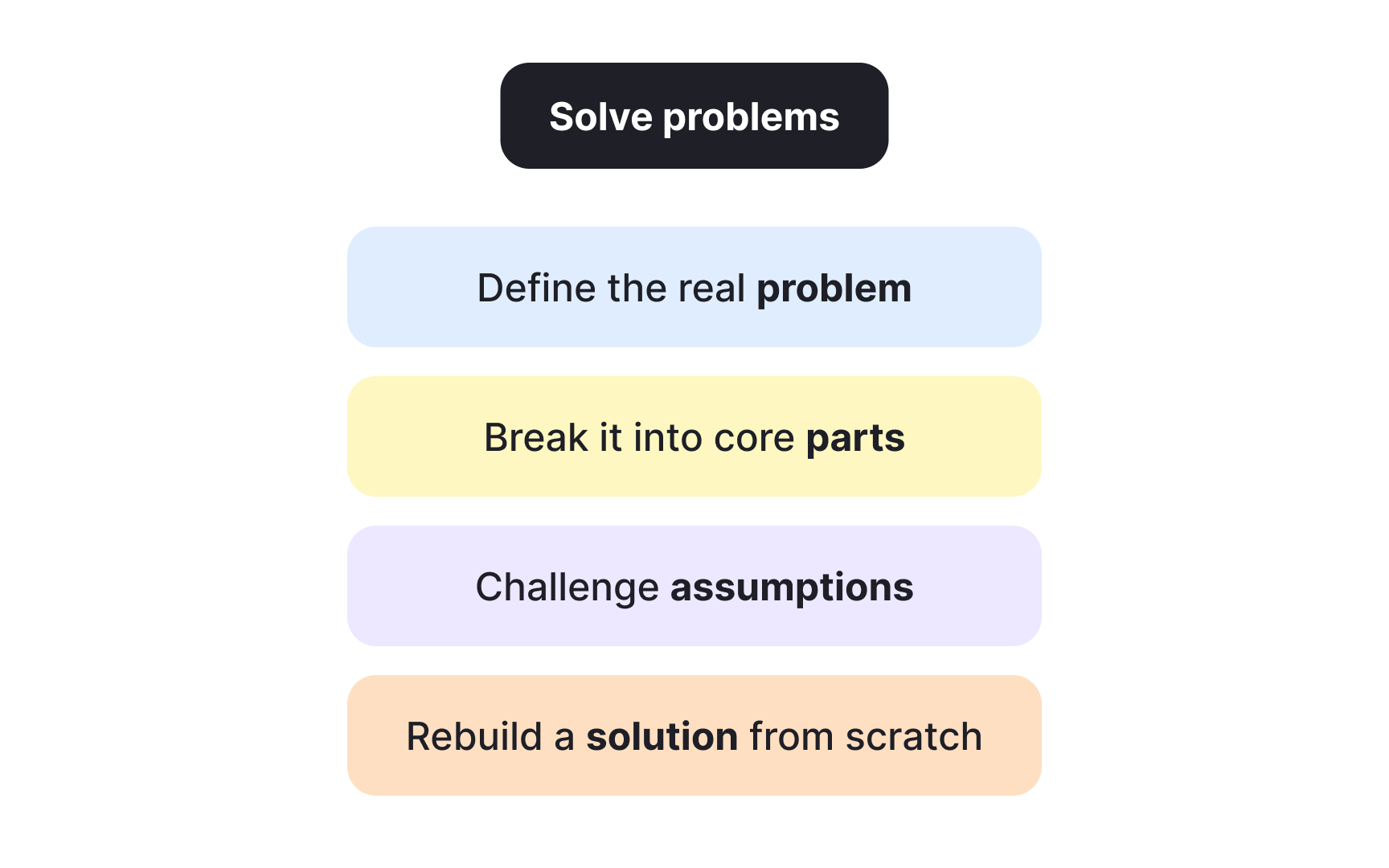
Thinking from first principles starts by clearing away assumptions and routine thinking. It directs PMs to identify the core truths of a problem before choosing any direction. This helps reveal constraints that no longer matter and patterns that exist only because they were repeated over time.
This mindset is valuable when progress stalls or when ideas feel too similar to past solutions. Familiar approaches can limit creativity by narrowing the problem. First principles thinking removes that limit and encourages questioning whether a feature, process, or belief is actually needed. This often leads to simpler and more effective options.
A first principles approach also supports clearer decisions. When reasoning is grounded in verified truths rather than habit, it becomes easier to explain trade-offs and align a team around the real problem.[2]
Pro Tip! When a solution feels predetermined, step back and check whether the underlying assumptions are still valid.
Form a clear problem hypothesis




A problem hypothesis turns a broad idea into a specific claim about a user problem. It replaces vague expectations with a statement that can be tested. An example of a problem hypothesis can be a statement about users wanting to complete a task but spending more time on it than they find acceptable. This kind of statement can be checked by asking users about their experience or reviewing data that shows how long the task normally takes
This approach keeps product work grounded in evidence. A clear hypothesis highlights what must be validated before moving forward and helps teams avoid building solutions based on assumptions or enthusiasm alone. If the hypothesis holds, it supports continued investment. If it does not, the team can redirect early and avoid unnecessary work.
A well-written hypothesis also strengthens alignment. It gives teams a shared understanding of the actual problem, which reduces confusion and makes feature discussions more focused.
Pro Tip! A strong hypothesis describes a user problem, not a feature. If it mentions the solution, rewrite it.
Decompose complex challenges
Complex product problems often contain many moving parts that can blur the real issue. Breaking these problems into smaller pieces makes them more manageable. Mental models support this by encouraging a cycle where events are observed, interpreted, and turned into simple decision rules that guide action. This cycle repeats as new information appears, which slowly reduces uncertainty and sharpens understanding.
Decomposition helps PMs see which elements truly need attention. Some pieces require data, others need user feedback, and some rely on judgment or trade-offs. When the problem is divided this way, it becomes easier to spot what should happen first and where the biggest risks or unknowns sit.
This method also reduces the cognitive load for both PMs and teams. Smaller parts are easier to discuss, evaluate, and explain. Instead of trying to solve everything at once, teams focus on one clear step at a time, which strengthens collaboration and leads to more confident decisions.
Pro Tip! When a problem feels tangled, sort it into parts you can measure, parts you can ask users about, and parts that need a decision.
Separate assumptions from facts


Product decisions often mix what is known with what is merely believed. Treating both as equal creates confusion and leads teams toward weak conclusions. Identifying which parts of a problem come from actual evidence and which come from assumptions protects PMs from relying on intuition that may be inaccurate. Mental models help slow down this process so decisions reflect real signals rather than quick guesses or habits
Clear separation also improves how teams work together. When facts and assumptions are labeled openly, discussions shift from defending opinions to checking what needs proof. This reduces unnecessary debate and keeps attention on gathering the right information. It also strengthens resilience in ambiguous situations because the team knows exactly which pieces of the problem require validation.
With this clarity, PMs can make more reliable choices even when information is limited. They understand which assumptions are safe enough to move forward and which require investigation before taking the next step.
Pro Tip! When reviewing a decision, highlight every statement that cannot be backed by evidence. Those are your assumptions.
Use inversion to reveal blind spots


Inversion flips a problem so it can be viewed from the opposite angle. Instead of asking what would help a product succeed, PMs ask what would cause it to fail. This shift exposes risks and weak points that traditional forward thinking can overlook. Inversion helps break repetitive thought patterns and disrupts assumptions that teams may treat as universal truths.
This model is especially useful when solutions feel predictable or when discussions circle around the same ideas. By exploring what would create poor outcomes, PMs uncover hidden dependencies, design pitfalls, or unintended effects that need attention. Avoiding these destructive paths can be as valuable as choosing the right feature to build.
Inversion also encourages more creative thinking. Looking at a familiar challenge from the opposite direction often reveals insights that are difficult to see when approaching the problem head-on. This leads to clearer priorities and more balanced decisions.
Pro Tip! If a problem feels stuck, ask yourself which actions would definitely make things worse. The opposite often points to the real solution.
Digging deeper with the 5 Whys
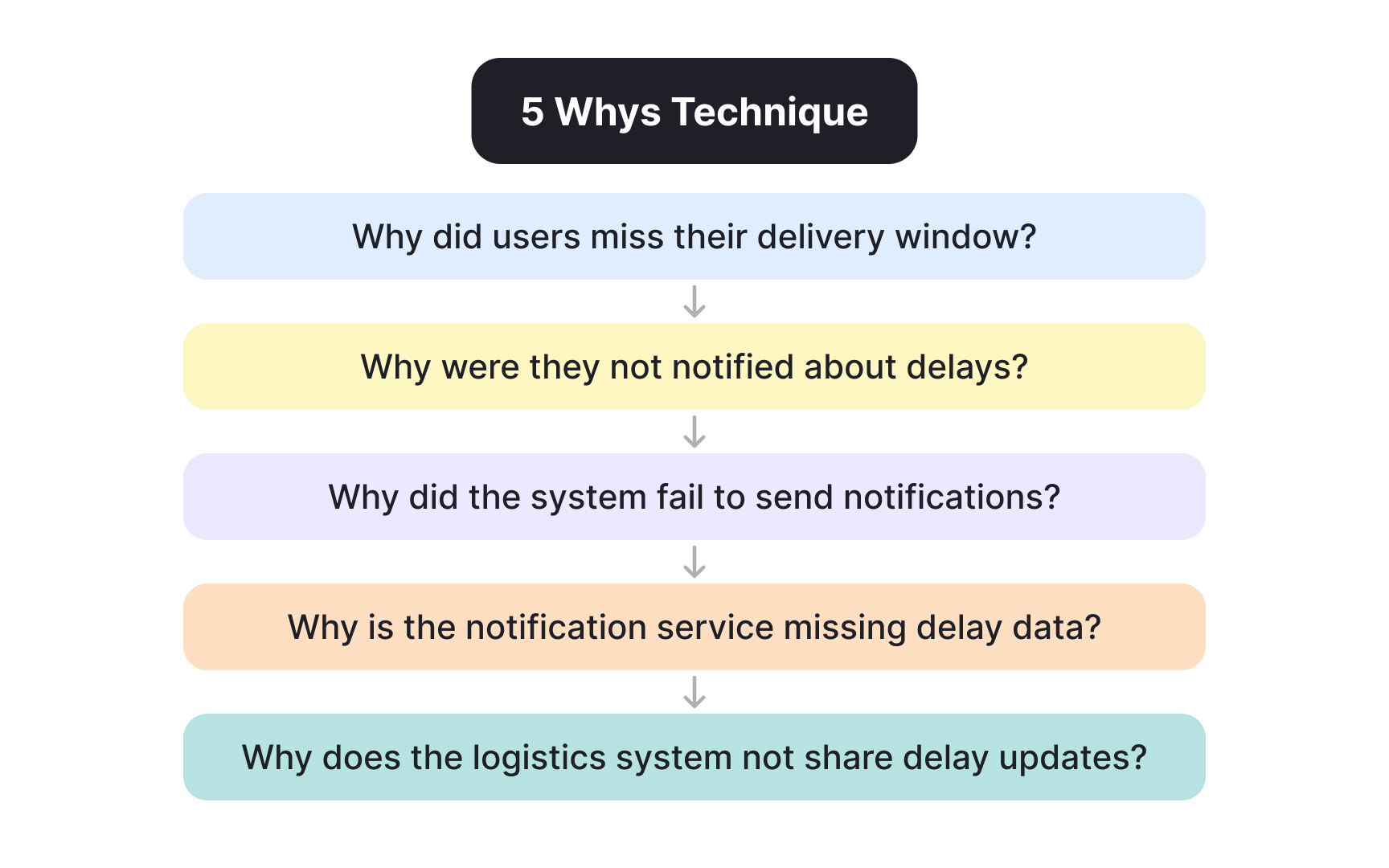
The 5 Whys model helps uncover the root cause of a problem by repeatedly asking why an issue occurred. Each answer leads to the next layer until the underlying reason becomes clear. This prevents PMs from reacting to surface symptoms that would only reappear later. The example in the source shows how a late delivery complaint reveals deeper operational gaps that would have stayed hidden without this step-by-step questioning.
This method brings structure to situations that feel urgent or confusing. It slows the decision process just enough to avoid quick fixes that fail to address the real issue. By tracing the chain of events, PMs gain insight into how systems behave and where changes will have the most impact.
Using the 5 Whys also strengthens cross-functional work. Each level of questioning often involves different teams or processes, which helps uncover misalignments or missing connections. This leads to solutions that last instead of temporary patches.
Pro Tip! Stop the process when further whys no longer reveal new information. That point usually marks the true root cause.
Applying structured thinking under pressure
PMs often face situations where decisions must be made quickly while information continues to shift. Structured thinking helps maintain clarity in these moments. Mental models support a cycle in which events are observed, interpreted, and turned into actionable rules. Repeating this cycle builds a more accurate understanding of the problem and reduces impulsive choices.
This approach keeps decisions grounded in a consistent pattern rather than mood or pressure. It helps PMs explain their reasoning clearly to others, which is essential when teams need direction despite uncertainty. A structured mindset is particularly helpful in case studies or real product scenarios where interviewers or stakeholders watch how thinking unfolds, not just the final answer.
Over time, structured thinking becomes a reliable internal tool. It helps PMs stay focused on what matters, avoid distractions, and adjust calmly as new information emerges.
Pro Tip! When time is tight, define the smallest set of facts you trust and base your next step only on those.
Evaluate incomplete information
PMs rarely receive fully reliable or complete data. Decisions often depend on partial signals, conflicting inputs, and assumptions that need constant adjustment. Mental models help PMs work within this reality by offering ways to process new information, refine understanding, and update conclusions rather than treat decisions as final. This steady adjustment reduces the impact of bias and prevents overconfidence when evidence is thin.
Evaluating incomplete information also means recognizing how much confidence each assumption deserves. Some assumptions are safe enough to move forward, while others require validation before acting. This balance keeps momentum without ignoring risk. It also improves communication because PMs can explain which parts of a decision are solid and which are conditional.
This mindset is valuable in case studies and real product settings, where interviewers and teams watch how PMs justify their reasoning. Thoughtful evaluation shows maturity and reduces the likelihood of chasing misleading signals.
Build a personal model toolkit
No single mental model works for every situation. Each model highlights certain patterns but overlooks others, so relying on only one can limit judgment. A more reliable approach is to use several models that view the problem from different angles. When these perspectives complement one another, they help reduce blind spots and strengthen the overall reasoning process.
A toolkit like this develops over time. As PMs face new challenges, they learn which models help clarify decisions and which ones are less useful in specific contexts. With continued practice, selecting the right model becomes quicker and more intuitive. This flexibility makes decision-making more resilient and helps avoid shortcuts that lead to errors.
Using multiple models also improves collaboration. Different stakeholders think in different ways, and shifting to a model that resonates with their perspective can make discussions clearer and more productive.
Pro Tip! When your thinking feels stuck, try approaching the problem with a model you have not used yet.