


A customer who books a flight, checks in on the app, waits at the gate, and calls support about a lost bag has had one experience, even though 4 different departments produced it. Service design is the discipline that takes responsibility for that whole, including the staff, systems, and processes the customer never sees. Most service failures happen in the handoffs between teams, which is exactly the territory no single product owner is looking at. As more services stretch across apps, physical spaces, and human support, that gap is where the work is.
In this glossary topic:

What is service design?
Service design is the practice of planning and shaping how a service works across every touchpoint and over time, covering both what the customer experiences (the frontstage) and the people, systems, and processes that make each moment possible (the backstage). Where product design tends to focus on a single interface, service design treats the interface as one touchpoint among many: the website, the app, the store, the call center, the delivery driver, the invoice, and the follow-up email are all part of the same service.
The field grew out of service marketing and operations. Lynn Shostack's 1984 Harvard Business Review article "Designing Services That Deliver" argued that services should be designed as deliberately as physical products and introduced the service blueprint to do it. Since then the discipline has borrowed from design thinking, systems thinking, and organizational change, which is why a service designer's week can include interviewing customers, mapping a back-office process, and facilitating a workshop with operations staff.
What does service design cover?
Service design works with 3 raw materials: people, props, and processes. People are the customers and the employees who deliver the service. Props are the physical and digital things the service uses, from a check-in kiosk to a confirmation email. Processes are the sequences and rules that connect them, most of which the customer never sees.
The discipline's 6 principles, codified by Marc Stickdorn and colleagues in "This Is Service Design Doing," describe how those materials get handled:
- Human-centered: the service is designed around the experience of everyone it touches, staff included.
- Collaborative: stakeholders from across the organization design together rather than receiving a finished plan.
- Iterative: services are prototyped and adjusted in cycles rather than launched once.
- Sequential: the service is understood as a sequence of moments over time, not a snapshot.
- Real: research and prototyping happen in real contexts with real people, not in slide decks.
- Holistic: the whole service and the organization behind it are in scope, not one channel.
The backstage is where most service design effort goes, because the customer-facing moment is usually the visible symptom of an internal process. A support call that takes 20 minutes is rarely a call-script problem; it is usually a systems or handoff problem that the script is compensating for.
How does the service design process work?
The process is usually taught as 5 phases. Research builds an understanding of the current service ecosystem: who is involved, what they do, and where the experience breaks. Ideation generates a wide range of options before narrowing to the promising ones. Prototyping and testing try those options cheaply, using methods suited to experiences that unfold over time rather than to screens. Implementation turns a validated prototype into an operational service, which means changing processes, training, and systems. Evaluation and iteration measure the live service and feed the next cycle.
Two artifacts carry the work between phases. A customer journey map lays out the customer's experience stage by stage with actions, emotions, and touchpoints. A service blueprint keeps those stages and adds the rows beneath them: frontstage actions by staff, backstage actions, and the support processes and systems each one depends on, separated by the line of interaction, the line of visibility, and the line of internal interaction. The blueprint is what turns an empathy exercise into an operational plan, because it names the internal owner of every customer moment.
How does service design differ from UX design?
The two disciplines share research methods and a user-centered stance, and in practice many people move between them. The difference is scope. UX design is responsible for the experience of a product, usually a digital one, and its unit of work is the interface, the flow, and the interaction. Service design is responsible for the experience of a service, and its unit of work is the touchpoint sequence and the organization that delivers it.
A UX designer redesigning a bank's app improves how a customer disputes a charge on screen. A service designer working on the same problem asks why disputes happen, which teams touch a dispute, how long the backstage review takes, what the customer is told meanwhile, and whether the branch staff and the app give the same answer. UX design owns the moment; service design owns the sequence of moments and the machinery behind them. Service design also overlaps with customer experience management, which measures and governs the experience; service design is the making discipline that changes it.
Why does service design matter for product teams?
Product teams increasingly ship things that are services in disguise. A subscription meal kit is an app plus a warehouse plus a driver plus a refund policy. A telehealth product is a booking flow plus a clinician's calendar plus a pharmacy integration. When the app is polished and the service around it is not, the app gets blamed in the reviews.
Service design gives product teams a way to see and own that surrounding system. Disney's park experience, from ticket purchase through ride wait times to the exit, is a well-known example of a service designed as one sequence rather than as separate operations. Airlines such as Singapore Airlines have applied the same thinking to booking, check-in, in-flight, and arrival as one designed experience. For a product team, the practical payoff is that the roadmap starts to include the process and policy fixes that actually move retention, not only the screen fixes that are easiest to ship.
What does service design look like in practice?
The service blueprint below is the discipline's signature artifact. Reading left to right follows the customer through the service; reading top to bottom at any column shows everything the organization has to do, visible and invisible, to deliver that one moment.
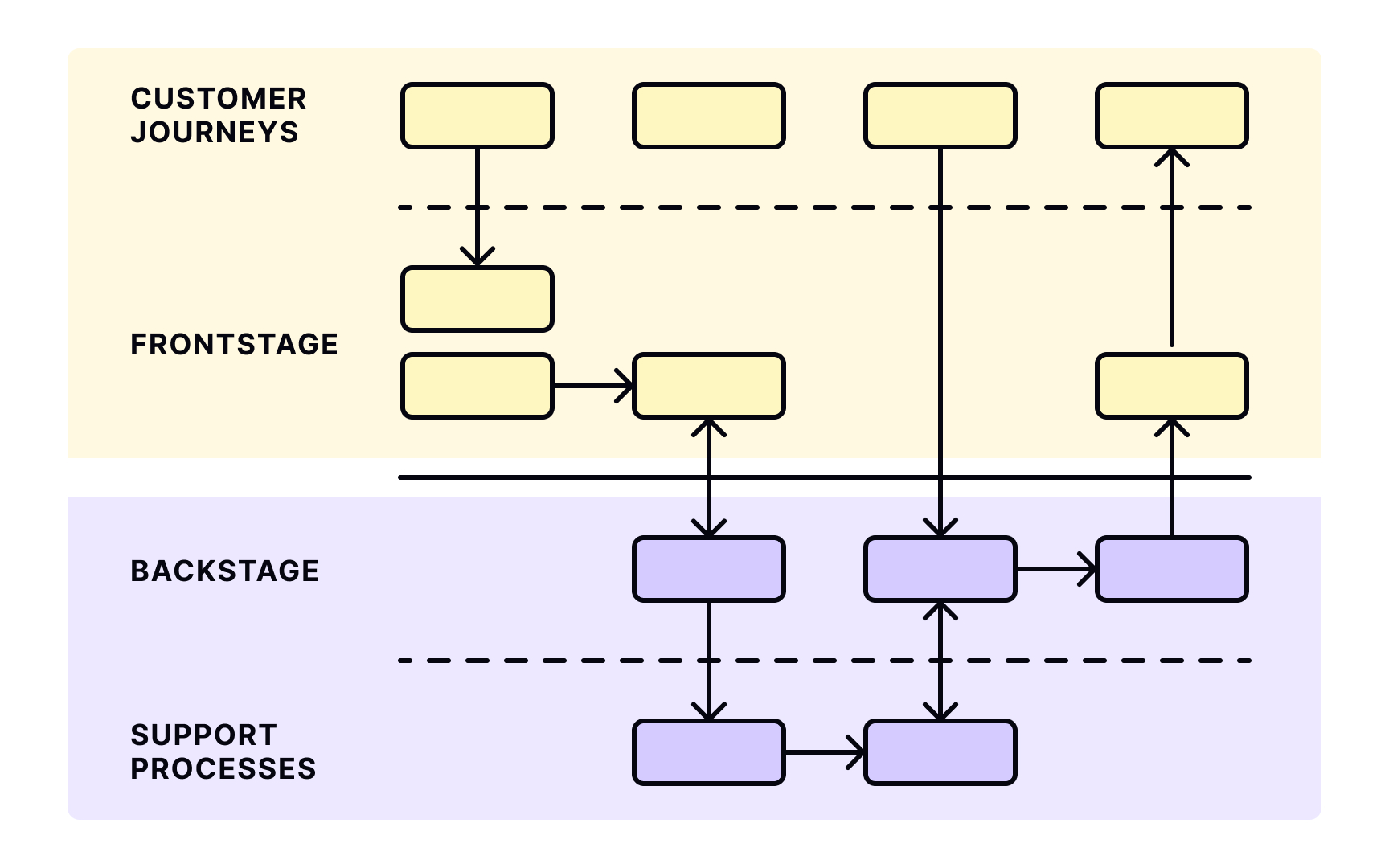
A service blueprint stacks what the customer sees above the line of visibility and what staff, systems, and processes do below it, so every customer moment has a named internal owner. From the lesson Guide to Service Blueprinting.
The 3 horizontal lines are what make a blueprint more than a journey map. The line of interaction separates the customer from staff, the line of visibility separates what the customer can see from what happens backstage, and the line of internal interaction separates frontline staff from the support processes they rely on. Most redesign opportunities sit at a line crossing, where a handoff between two parties adds a delay or loses information.
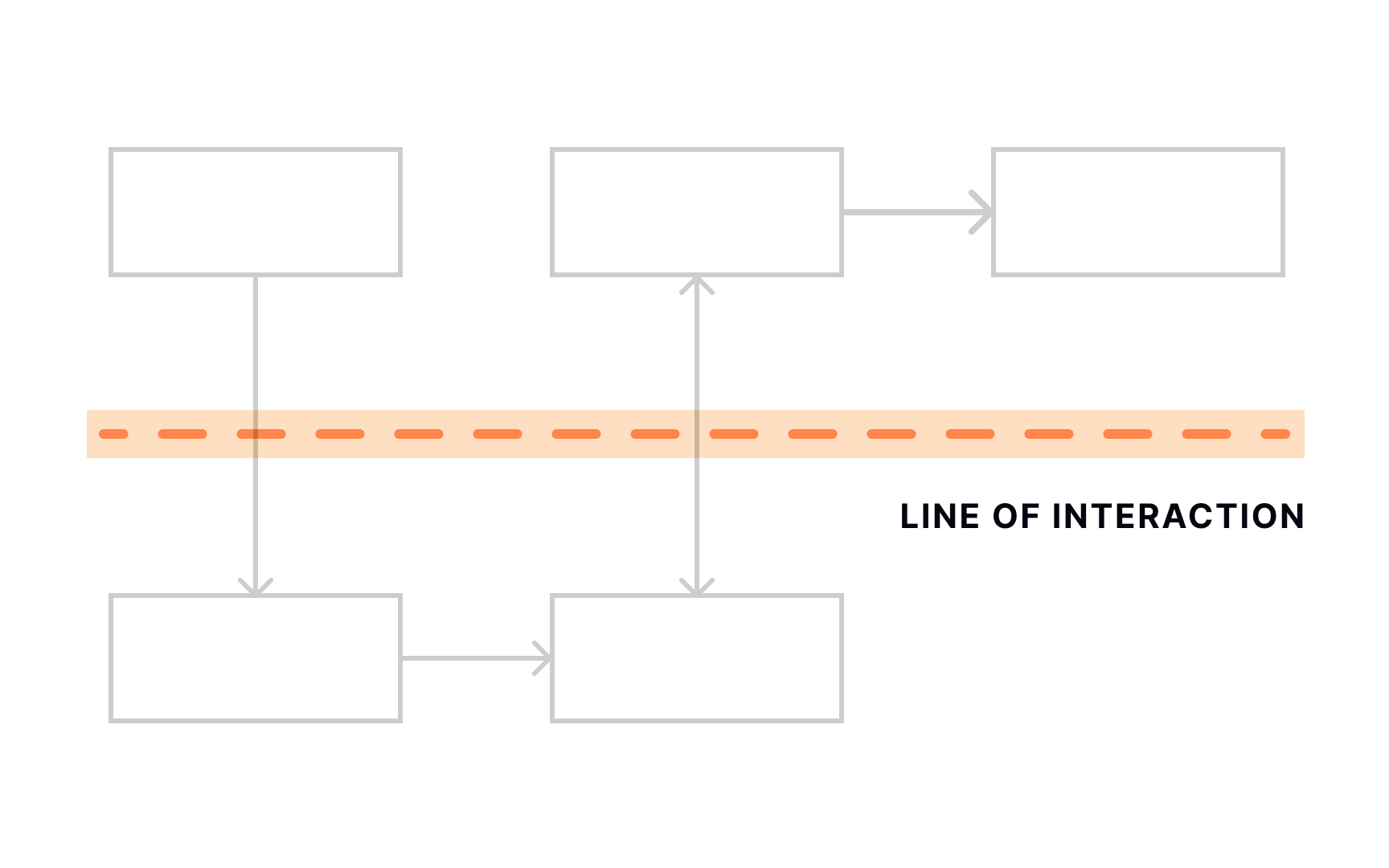
The line of interaction, the first of a blueprint's 3 primary lines. Each line marks a handoff, and handoffs are where waiting, repetition, and contradictory information enter a service.
How to learn service design
Foundations: what a service is and how the process runs
Service design starts with a shift in what counts as the product. The What Is Service Design? lesson sets out why experiences that span websites, apps, call centers, and physical spaces need to be designed as one thing, and the Service Design Process lesson walks through the 5 phases from research to evaluation. The Core Principles of Service Design lesson then gives the 6 principles that guide decisions when the tradeoffs get uncertain, which is most of the time. Learners coming from design thinking will recognize the shape and notice how much wider the scope is.
Connecting the service to the business
A service that delights customers and loses money does not survive long enough to matter. The Business Model Canvas lesson covers how to lay out customer segments, channels, costs, and revenue on one page so that design decisions can be checked against viability early. This is also the point where stakeholder management becomes a design skill, since service changes usually need budget from people who do not attend design reviews.
Researching the current service
Service research has a specific job: understanding the current ecosystem well enough to find the opportunities worth pursuing. The Service Design Research Planning lesson covers setting research goals and building a plan before spending on fieldwork, and the Personas vs. Jobs to Be Done lesson compares two ways of modeling the people in the service and when each fits. Familiarity with UX research methods carries over directly; the difference is that staff get interviewed as carefully as customers.
Mapping the journey and the blueprint
Mapping is where research becomes a shared picture. The Customer Journey Mapping for Service Design lesson covers the customer's side: phases, channels, emotional highs and lows, and the "what if?" lane for ideas. The Guide to Service Blueprinting lesson, credited under the figure above, extends the map downward into frontstage and backstage actions and support processes. Related artifacts such as the experience map and the ecosystem map widen the frame further when the service touches partners and third parties.
Ideating with the people who deliver the service
Service ideas that exclude frontline staff tend to be undeliverable. The Pre-Ideation and Fast Idea Generation Techniques lesson covers generating a high volume of options quickly, the Activities for Defining Deeper Ideas and Ranking lesson covers developing and comparing them, and the Ideation Methods for Narrowing Down Ideas lesson covers reducing the set without killing the odd ones too early. The How to Run Co-Creative Workshops lesson brings operations, support, and customers into the same room, which is where workshop facilitation skills pay off.
Prototyping, implementing, and keeping the change alive
Services are prototyped differently from screens. The Quick Guide to Building Service Design Prototypes lesson covers matching the prototype's fidelity to the question and the budget, and the Service Design Prototyping Methods lesson covers methods built for experiences that unfold over time, such as role-play, desktop walkthroughs, and pilot runs. The How to Implement Changes in Service Design lesson covers the part where most projects stall: moving from a validated prototype to an operational service that sticks. For a longer walkthrough of the components, principles, and process in one place, the article on the people, props, and processes behind a service is the deep guide.


