


.svg)

Timing is one of the most consequential variables in go-to-market strategy and one of the least systematically managed. Most founders assess their product, pricing, and channel choices with rigor, then pick a launch date based on when they happen to be ready. That gap is where timing failures are made.
Consumer markets follow seasonal rhythms that concentrate intent into predictable windows. B2B markets operate on budget cycles that create active buying periods and genuine freeze periods. The competitive position a company enters, whether as a first mover educating a category or a fast follower improving on a proven concept, changes which investments make sense and which will be wasted.
Beyond seasonality and competition, there are deeper structural questions. Is the market's technology infrastructure ready to support the product? Have the behavioral norms on which the product depends been formed at scale? Are regulatory conditions creating urgency or freezing decisions? These questions have answers, and answering them before setting a launch calendar is what separates a go-to-market plan that works with the market from one that fights it.
How timing failures masquerade as product failures
Post-mortems on failed products rarely name timing as the cause. Instead, they point to product-market fit, weak execution, or team issues. The symptoms look similar, but the underlying cause is different. When a market is not yet ready for a solution, customers respond with indifference rather than enthusiasm, and that indifference reads as a product problem when it is a timing problem. This matters for how founders interpret early signals. If customers are not adopting despite strong positioning and a functioning product, timing is worth examining before concluding the product is broken. The question is not just "does our product solve a real problem" but "is this market at the point where that problem feels urgent enough to act on."
A compliance software company that launched two years before a major regulatory deadline found limited traction. The same product, repositioned and relaunched in the months approaching that deadline, converted at a dramatically higher rate with the same team. Nothing about the product changed. What changed was how acutely customers felt the problem and how immediately they needed to act on it.[1]
Pro Tip! Before diagnosing a product problem, map the timing conditions at play: budget cycles, seasonal patterns, and regulatory signals.
Seasonality patterns in consumer markets
Consumer behavior follows predictable seasonal rhythms, and aligning marketing investment with those rhythms is one of the most reliable ways to improve conversion efficiency. A fitness product launched in January rides a wave of cultural attention around new habits. The same product launched in August competes for attention during a quieter window with less intent behind the searches.
The practical implication is not that founders should wait for the "perfect" season to build or validate, but that peak investment should align with peak receptivity. Spending that drives conversions in December for a holiday-adjacent product will produce a fraction of the same results if deployed in February. This is not a minor efficiency gain. For consumer businesses with limited acquisition budgets, deploying spend outside the peak window can make the difference between profitable growth and a campaign that looks efficient on paper but never builds enough momentum to compound.
Understanding seasonality means analyzing historical data, not relying on intuition. Tools like Google Trends reveal when search interest peaks for a category, giving a measurable signal to plan against.[2]
B2B budget cycles and annual planning rhythms
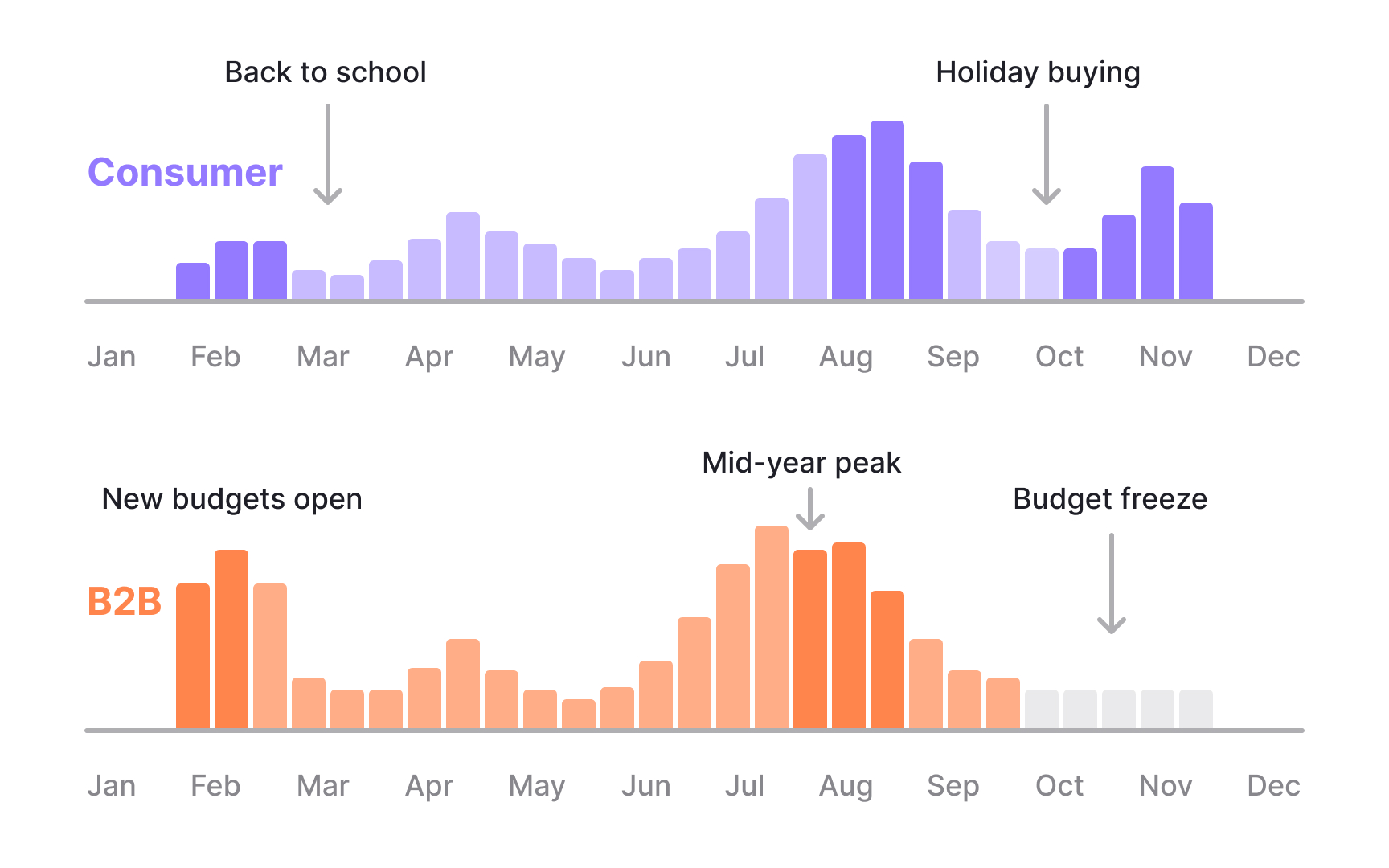
Enterprise and mid-market companies operate on annual planning cycles. Budget decisions made in Q4 determine the priorities and approved vendors for the following year. A product entering sales conversations in October, when procurement teams are consumed by year-end close and next-year planning, encounters a very different reception than the same product arriving in February, when new budgets are active.
Research across 27 B2B categories found that the large majority peaked in January or March, reflecting the effect of fresh annual budgets releasing pent-up purchasing intent. This Q1 window is not a tactical detail. It is a structural feature of how corporate spending decisions are made and sequenced.
Knowing the fiscal calendar of target customers adds a layer of advantage that is easy to overlook. A company whose largest prospects run September fiscal years should not plan major outreach pushes for March. Aligning campaigns to the periods when buyers have both budget authority and active intent is the difference between efficient pipeline generation and a well-executed effort that still underconverts.[3]
First mover vs. fast follower as an entry timing decision
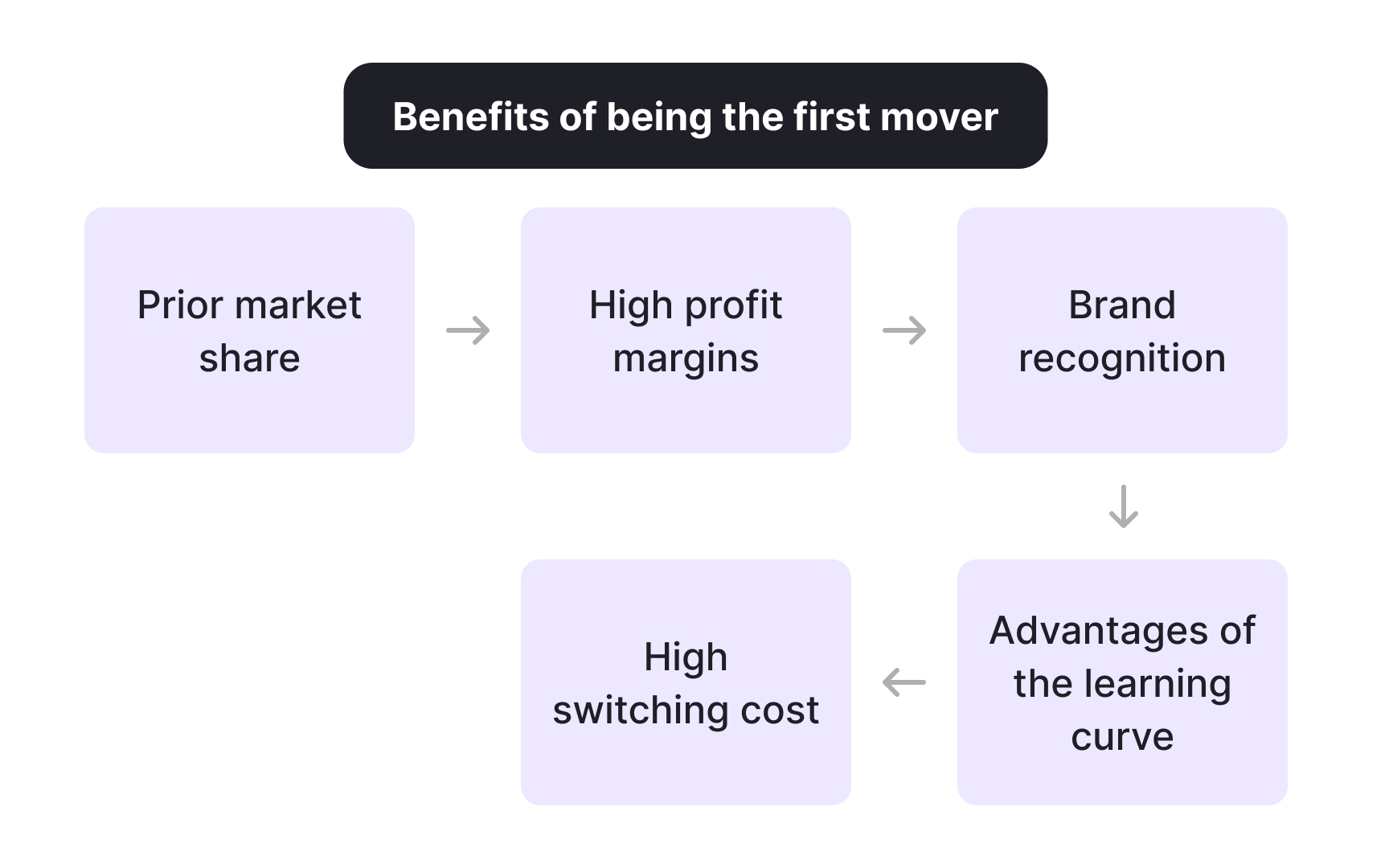
The first mover into a new market bears the cost of category creation: educating customers that the problem is worth solving, that the category of solution is credible, and that this specific product can deliver. Competitors who enter later harvest demand that the pioneer created it without paying to create it. Fast followers capture leadership positions in more markets than first movers do. This does not mean being first is always a disadvantage. First movers can establish brand associations with the category itself, accumulate proprietary customer data, and build switching costs before competitors arrive. These advantages hold when the first mover also moves quickly enough to prevent competitive entry before lock-in occurs.
The strategic question is not "first or fast follower" as a binary, but which position fits current capabilities. A fast follower should invest in differentiation and the underserved segment that the leader is not fully serving. A first mover's investment should go into category education and building switching costs before competitors arrive with a cheaper version of the same idea.[4]
Pro Tip! First movers should invest in switching costs and category education. Fast followers should invest in the underserved segment that the leader is not fully serving.
Technology and behavioral readiness as timing prerequisites

Some products fail not because the idea is wrong but because the market infrastructure to support them does not yet exist. A product that requires widespread smartphone adoption as a prerequisite cannot succeed in a market where smartphones are a minority device. A product that assumes corporate buyers are comfortable storing sensitive data in the cloud will encounter a fundamentally different market in 2008 than in 2018, even if the product itself did not change.
Google Glass is the clearest recent example. The technology worked. The use case was real. But consumers and regulators were not ready to accept camera-equipped eyewear in daily social contexts. The same category, relaunched a decade later as the Ray-Ban Meta smart glasses, reached a market where behavioral norms and privacy expectations had shifted enough to make adoption plausible.
The questions to answer before a major go-to-market investment include:
- Has the enabling infrastructure reached sufficient adoption in the target market?
- Do customers already understand the category well enough to evaluate a specific solution?
- Does the product depend on habits or norms that have not yet formed at scale?[5]
Regulatory windows as go-to-market timing catalysts
Regulatory changes create timing conditions that cannot be manufactured. A new data privacy law creates immediate demand for compliance tools from every affected organization, often within a fixed deadline. A change in healthcare reimbursement rules generates demand for billing software that supports the new model. The urgency is externally imposed, and the window for selling into it is finite.
Launching before a regulatory deadline, when urgency is highest, and the problem is most salient, produces different conversion economics than launching after the deadline has passed. The remaining non-compliant organizations are the hardest buyers to move. The opportunity concentrates in the run-up.
Regulatory uncertainty creates the inverse problem. Buyers waiting for rules to stabilize before committing to technology investments are genuinely blocked, regardless of how strong the product is. Timing a major go-to-market push into regulatory uncertainty means competing for the attention of buyers whose decisions are frozen. The right response is to use those periods for product development and relationship-building, then move hard once clarity arrives.[6]
Recognize bad timing scenarios
Timing errors are systematically underdiagnosed because they resemble other failures. A consumer app launched in August that never gains momentum gets attributed to weak messaging or product gaps, not to a seasonal trough. A B2B sales push running through November and December produces poor pipeline numbers attributed to pricing or positioning, not to budget freeze cycles that had nothing to do with the product.
Recognizing bad timing scenarios requires mapping the structural factors at play before attributing poor results to product or execution:
- Is the target customer type in a budget freeze period?
- Is the category in a seasonal trough?
- Is the market, undergoing regulatory uncertainty, holding buyers in wait mode?
- Has enabling technology not reached the adoption threshold the product needs?
Bad timing does not mean a company is wrong about its market. It means the investment is swimming against the current. Redirecting that investment to a better-positioned window would produce stronger results without changing anything else. The diagnostic habit is asking "what timing factors might explain this" before defaulting to product or messaging as the explanation.[7]
Build a timing-aware go-to-market launch calendar
Translating timing intelligence into a launch calendar requires mapping the variables that apply to a given product and customer type. For a consumer product with strong January intent, that means building content and paid campaigns to go live in late December, because the intent wave builds before the calendar turns. For a B2B enterprise product, it means initiating sales conversations in Q3 to allow for a sales cycle that closes when Q1 budgets open.
The inputs to a timing-aware calendar are:
- The seasonality pattern for the customer type
- The budget cycle of the target segment
- The competitive entry position
- Any regulatory deadlines creating urgency
- An honest assessment of behavioral and technology readiness
These variables do not need to align perfectly, but they should all be named before the calendar is set.
The output is a prioritized set of go-to-market investment windows with specific triggers for each commitment. The January outreach push starts in November. The conference sponsorship that reaches buyers during active evaluation happens in Q2, not Q4. Each investment decision is anchored to a timing rationale, not just a marketing schedule.[8]
Topics
References
- How to Time Your Product Launch for Maximum Success | American Marketing Association
- How To Research And Capitalize On Seasonal Buying Cycles | Martech Zone | Martech Zone
- Inside the B2B Buying Cycle: 2.5 Years of U.S. Search Behavior, Mapped | DesignRush
- Fast Follower vs First Mover: Choosing the Right Strategy
- How to Time Your Product Launch for Maximum Success | American Marketing Association
- Understanding Business Seasonality in B2B Marketing - Intelemark | Intelemark
- Often Overlooked, Always Important: Business Seasonality in B2B Marketing - Respect.Studio | Respect.Studio
- How To Research And Capitalize On Seasonal Buying Cycles | Martech Zone | Martech Zone