



Most agents work through tools built for them, such as a search function or a connector to an email account. Plenty of software has no such connection, so a newer kind of agent works the way a person does: it looks at screenshots, moves a cursor, and types. That reach comes at a price. Clicking through screens is slower, costlier, and easier to knock off course than a direct connection, and an agent working inside your signed-in browser can do anything you could do there.
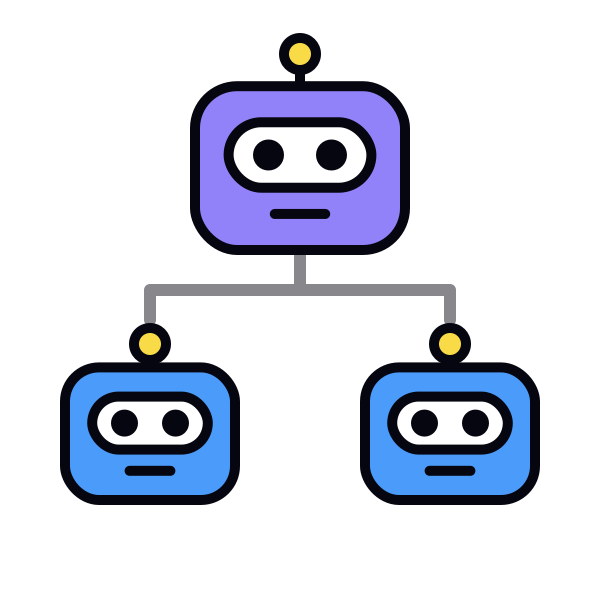
Some tasks are also too big for one agent to handle well. Research tools and coding agents now split the work across a team, with a lead agent in charge and several helpers working at once, each starting with a fresh context. The lead splits the task, hands each piece to a helper, and combines what comes back, and the helpers are often the same model playing a narrower role. On the right task, a team finishes faster and covers more ground than a single agent.
On the wrong task, it burns many times the tokens and trips over its own coordination. Helpers that read, research, and review tend to pay off, while helpers that all edit the same work tend to clash. Both halves follow one rule: use the simplest setup the task allows, and add more only when it clearly earns its cost.
Computer use
Computer use is an agent operating software the way a person does. Instead of calling a tool built for one app, it looks at the screen, moves a virtual mouse, clicks buttons, and types text. Anthropic released the first version in public beta in October 2024, and OpenAI followed in January 2025 with the model behind Operator.
The mechanism is surprisingly literal. Anthropic explains that Claude "looks at screenshots of what's visible to the user, then counts how many pixels vertically or horizontally it needs to move a cursor in order to click in the correct place." Each screenshot is a still image, so the agent sees the screen more like a flipbook than a video and can miss a notification that appears and vanishes between shots [1]. It's the same observe, decide, act, check loop every agent runs, with the screen as the tool.
The appeal is reach. Anthropic framed the goal as AI that can "use essentially any piece of software as instructed," not only the apps someone has built a connector for [2]. Computer use has since become a built-in mode rather than a separate product: OpenAI's ChatGPT Work, launched 9 July, 2026, includes a desktop Computer Use mode that clicks, types, and moves files across a person's apps [3]. On OSWorld, a standard test of everyday computer tasks, vendor-reported scores rose from about 15% in late 2024 to above the roughly 72% that people achieve [4].
Screens vs. APIs
An API, or application programming interface, is a direct, structured way for one piece of software to exchange data with another. Connectors that link AI apps to services like email and calendars are built on this kind of access. When a direct connection exists, an agent should use it. Clicking through screens is the fallback for software that offers no other way in.
Nielsen Norman Group (NN/g) describes 3 ways an agent can work with an interface [5]. From most to least costly:
- Screenshots: The agent reads raw pixels, an approach NN/g calls "slow, computationally wasteful, error-prone, and token-intensive." A single screenshot costs tens of thousands of tokens, the units of data a model processes and charges for.
- The accessibility tree: The agent reads the labeled map of buttons and fields that screen readers use, which costs a few thousand tokens.
- Direct API access: The agent skips the interface entirely and trades structured data with the software.
Clicking is also slow and easy to knock off course. In an August 2025 test, NN/g found ChatGPT agent took 11 minutes to work through a restaurant's booking forms that a person finished in about 2, and it picked the wrong time slot while scrolling [6]. Screens still matter, though. As Google DeepMind put it, "many digital tasks still require direct interaction with graphical user interfaces, for example, filling and submitting forms." [7] Capable agents mix both, using connections where they exist and the screen for everything else.
Agents inside the browser
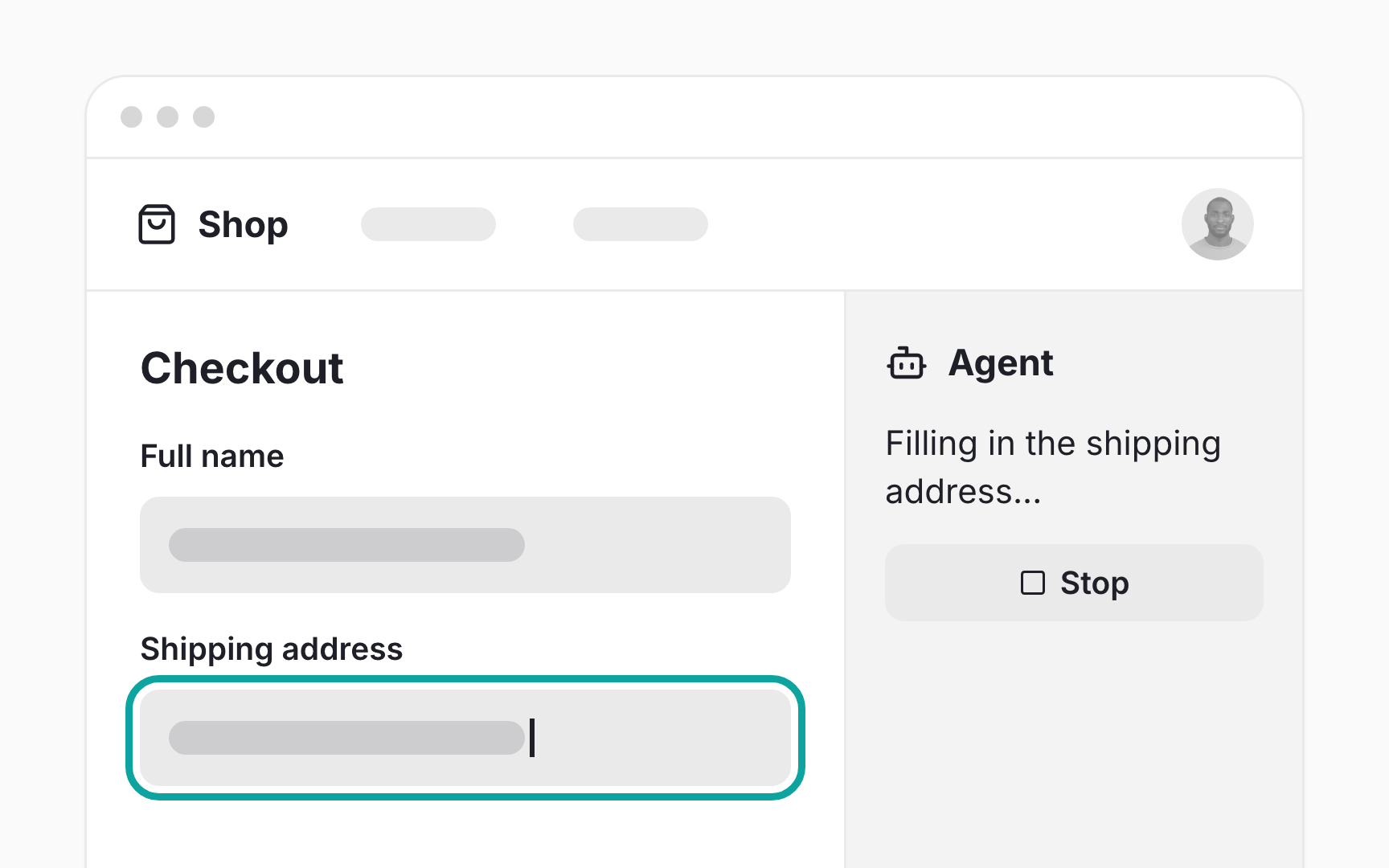
Early acting agents worked on a computer of their own. OpenAI's Operator, launched in January 2025, used "its own browser," and it handed control back to the person whenever a task needed a login or payment details [8]. Agents inside the browser reverse that arrangement. They run in the person's own browser, with its open tabs, history, and signed-in accounts.
That one change carries both the appeal and the risk. An agent that's already signed in can reach email, shopping carts, and work tools without anyone handing over a password, and it can do anything the person could do there. It also goes further than the AI sidebars many browsers now include. A sidebar summarizes or answers questions about a page. An agent in the browser opens tabs, fills in forms, and clicks submit.
Products in this space change quickly. OpenAI launched ChatGPT Atlas, a browser with a built-in agent mode, on 21 October, 2025. It announced the sunset on 9 July, 2026, and Atlas stopped working on 9 August, 2026, with its agent features moving into the ChatGPT desktop app and a Chrome extension [9]. The pattern itself kept spreading into existing browsers and extensions. An agent holding a person's logins also makes an attractive target for attackers.
Multi-agent systems
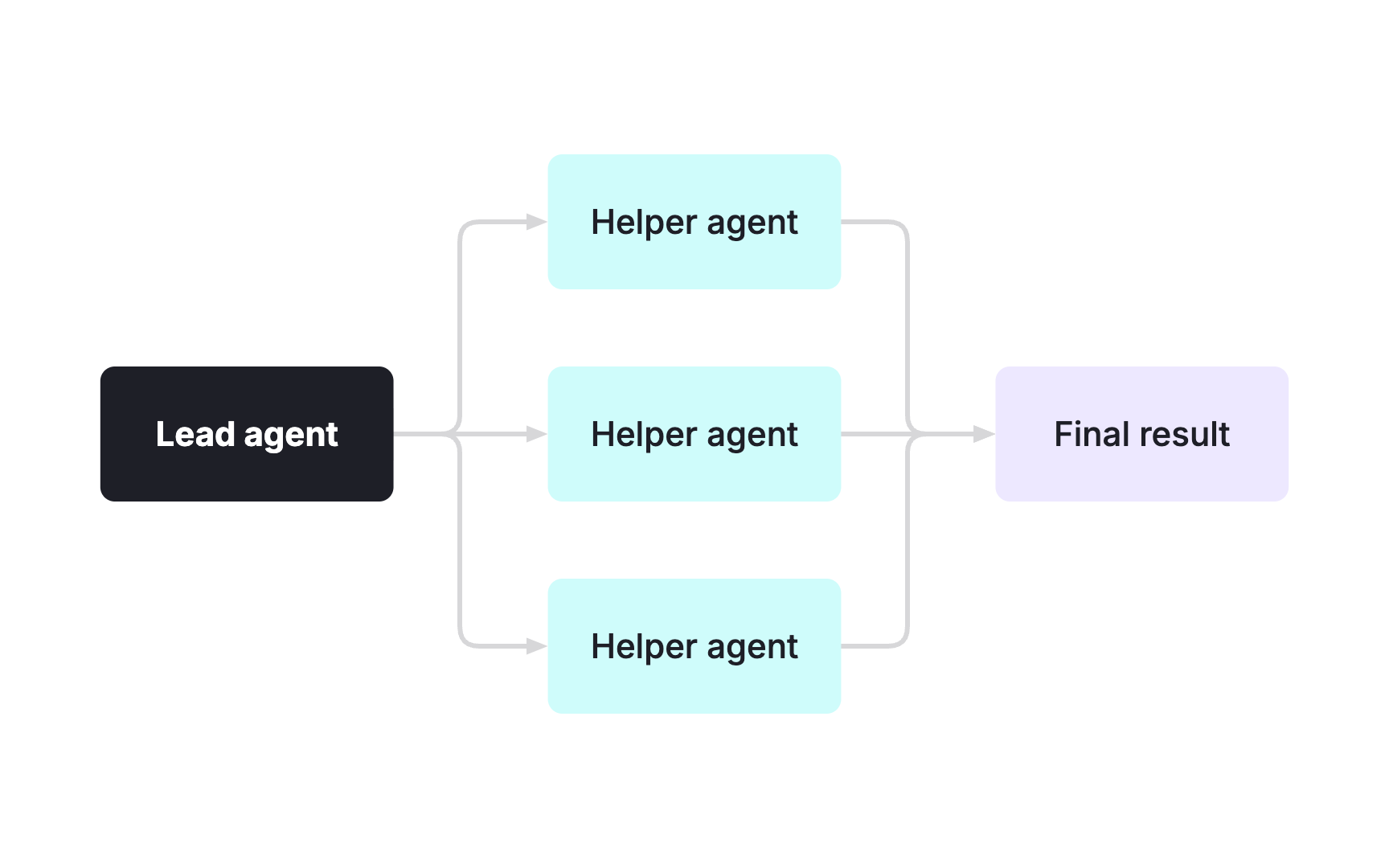
A multi-agent system is several agents working on one task. Anthropic defines it as "multiple agents (LLMs autonomously using tools in a loop) working together," where an LLM, or large language model, is the AI model at the center of each agent [10]. The most common shape has a lead agent, often called the orchestrator, that splits the task into pieces, hands each piece to a helper agent called a subagent, and combines what comes back.
Anthropic's research feature works this way, with a lead agent that plans the research and helpers that search in parallel. Asked to find every board member of the information technology companies in the S&P 500, the multi-agent version broke the job into pieces for its helpers and found the answers, while a single agent failed [11]. AI researcher Andrew Ng compares the setup to how managers "decide what roles to hire, and then how to split complex projects." [12]
Other arrangements exist, such as agents working side by side with no coordinator, but the lead-and-helpers pattern is the one most products use. Agents from different companies can also pass work to each other through A2A, an open protocol that joined the Agentic AI Foundation on 17 August, 2026 [13].
Benefits of splitting the work
Splitting a task across agents pays off for 2 reasons. The first is speed. Helpers working on independent pieces at the same time finish sooner than one agent working through them in order. In Anthropic's research system, the lead agent starts 3-5 subagents at once instead of one after another [14].
The second is focus. Each helper starts with a fresh context, the working memory an agent holds for a task, so it isn't weighed down by everything the lead agent has seen. Long contexts wear an agent down, so a clean start helps. A helper might work through tens of thousands of tokens on its piece, then return only a condensed summary, often 1,000-2,000 tokens [15].
On the right task, the payoff is large. Anthropic reported that its multi-agent setup outperformed a single agent by 90.2% on its internal research evaluation [16]. The helpers weren't smarter models: in that system they ran on a smaller model than the lead. What makes a helper specialized is its instructions, its tools, and the slice of the task it gets, and often it's the same model playing a different role.
The cost of agent teams
Agent teams are expensive to run. Anthropic found that a single agent uses about 4 times as many tokens as a regular chat, while a multi-agent system uses about 15 times as many tokens as a chat [17]. Its conclusion was that a team only makes sense when the task is valuable enough to pay for the extra performance. Early versions of its system also wasted effort, at times starting 50 subagents for a simple question.
Coordination adds its own failures. Google Research tested 180 agent setups and found that on tasks where each step depends on the last, such as planning, "every multi-agent variant we tested degraded performance by 39-70%." [18] On a finance task that split cleanly into parallel parts, a team with a lead agent did 80.9% better than one agent. A Berkeley study of more than 1,600 multi-agent runs found the gains on popular benchmarks were often small and identified 14 distinct ways these systems fail [19].
By 2026, views had converged on the shape of the task. In June 2025, Cognition co-founder Walden Yan argued against agent teams in "Don't Build Multi-Agents." His example was a Flappy Bird clone where one helper built a Super Mario-style background and another built a bird that didn't match, because each made its own unspoken design choices [20]. In a 22 April, 2026 follow-up, he wrote that the warning still held for agents writing in parallel, but endorsed setups where "writes stay single-threaded." [21] Parallel writers are fragile, while helpers that read, research, and review for a single agent that makes the edits are where teams earn their cost.
Topics
References
- AI Agents as Users | Nielsen Norman Group
- Initial Impressions of ChatGPT’s Agent: Successful, Shaky, and Slow | Nielsen Norman Group
- Introducing the Gemini 2.5 Computer Use model | Google
- How we built our multi-agent research system
- Agentic Design Patterns Part 5, Multi-Agent Collaboration | DeepLearning.AI
- A2A joins AAIF’s open agentic stack - Agentic AI Foundation (AAIF) | Agentic AI Foundation (AAIF)
- How we built our multi-agent research system
- Effective context engineering for AI agents
- How we built our multi-agent research system
- Towards a science of scaling agent systems: When and why agent systems work
- Why Do Multi-Agent LLM Systems Fail? | arXiv.org
- Don’t Build Multi-Agents
- Multi-Agents: What's Actually Working



