

.svg)

Most companies don't outgrow their channels. They outgrow their approach to them. The move from one proven channel to many happens gradually, and companies that manage it well share one trait: they don't add complexity until the work of each stage is done.
Channel strategy follows the same maturity arc as everything else in go-to-market. At the earliest stage, only direct selling fits. Founders stay in every conversation and treat each interaction as a research session. That direct work generates foundational knowledge no partner or automated system can replicate. At the next stage, one focused experiment runs alongside the proven primary channel, not to replace it, but to test whether a second approach has enough signal to justify future investment. Later, 2 or 3 proven channels operate as a system, with active management of how they interact.
Each stage has a clear gate before the next one opens. Partners amplify what already works. Multi-channel strategies require a working primary channel to build from. Understanding what belongs at each stage, and what must wait, is the discipline that separates founders who scale from those who only accelerate their problems.
How channel strategy evolves by maturity stage
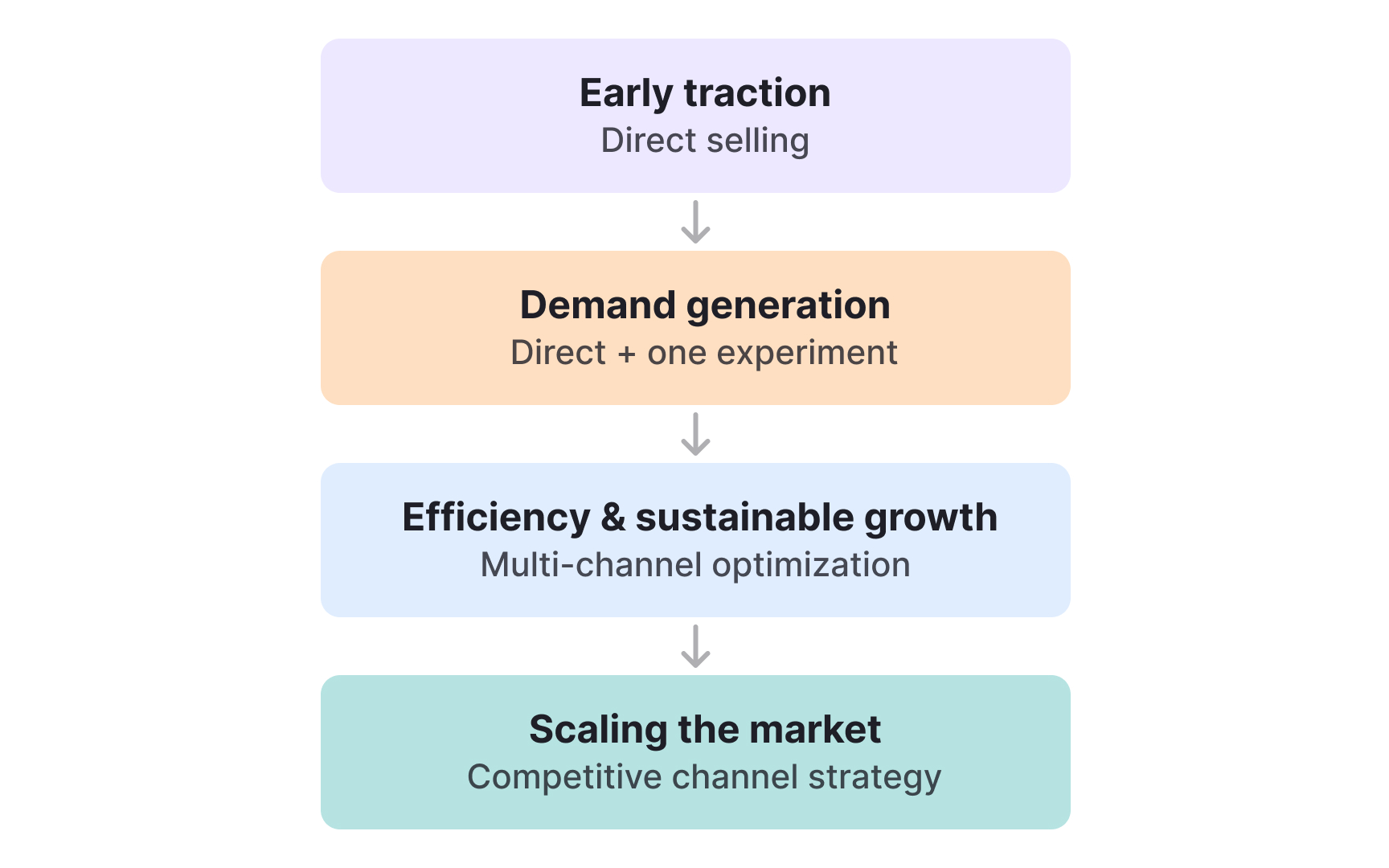
Channel strategy doesn't stay static as a company grows. It evolves in a deliberate sequence tied directly to what the business has proven at each stage:
- At Level 1, with 3-5 customers, there is only one appropriate approach: direct selling. Founders talk to customers personally, close deals themselves, and stay in every conversation. This isn't a temporary workaround. It's the only way to learn what actually resonates, what objections keep coming up, and how long the real sales cycle is. None of that learning transfers through a partner or automated flow.
- At Level 2, around 5-25 customers, the question shifts. Direct selling remains the primary revenue driver, but one focused experiment runs alongside it. A growth marketer might test a content channel, an affiliate program, or a self-serve signup flow. The goal isn't to build a second engine. It's to find out whether one new channel has enough signal to be worth investing in later.
- At Level 3, with 25-100 or more customers, the company doubles down on 2 or 3 proven channels and starts optimizing how they work together.
- At Level 4, channel strategy becomes a competitive tool. Decisions shift from finding what works to defending it through enterprise partnerships, dedicated channel teams, and brand-level investments that build category presence.[1]
Pro Tip! Channels don't compound until they're built on a foundation of real customer understanding from the stage before.
Why direct selling is the only right channel at Level 1
At Level 1, doing the selling yourself isn't just a resource constraint. It's the most important work the company can do. Every direct conversation produces information that no other source can provide at this stage. Founders learn which problem description actually resonates when said out loud. They discover which objections reappear in almost every meeting. They find out who in the customer organization has the real decision-making authority, regardless of title. And they get an honest reading of how long the sales cycle takes.
That learning becomes the foundation for everything built later. If a company hands off selling to a reseller or affiliate before this work is done, that knowledge gap follows them permanently. A reseller can't tell you why a prospect almost bought and then didn't. An automated onboarding flow can't surface the edge case that keeps blocking conversions. The manual, personal work of Level 1 selling forces founders to engage with the details that will eventually be systematized. Skipping it doesn't save time. It means building a repeatable process on top of an incomplete understanding of what you're actually trying to replicate.[2]
Pro Tip! The objection that comes up in 8 out of 10 Level 1 calls is your most important product and messaging signal.
Design a Level 2 channel experiment
At Level 2, adding one experimental channel alongside direct selling isn't about diversification. It's about finding the next thing that could work without abandoning what already does. Direct selling remains the primary source of revenue and learning. The experiment is a parallel bet, not a replacement. Choosing which channel to test comes down to 3 criteria:
- It should be testable without requiring new organizational infrastructure. A full reseller program is not a Level 2 experiment. A referral incentive for existing customers is.
- It should connect logically to what the company already knows about customers. If the buyer is a procurement manager at a mid-size manufacturer, the right experiment is outbound email, not a social campaign.
- It should produce a clear signal within 60-90 days. If the experiment can't return measurable data that quickly, it won't inform the next decision in time.
Running both in parallel also means resisting the urge to pause direct selling when the experiment shows early promise. One data point doesn't justify restructuring the channel approach. A signal needs to be consistent before it changes strategy.[3]
Pro Tip! If you can't define what "working" looks like for the experiment before you start, the result won't tell you anything useful.
Manage channel interactions at Level 3
Channels don't work in isolation at Level 3. When 2 or 3 proven channels are operating in parallel, they start to influence each other in ways that require active management. Customers might first encounter the product through a content piece, explore it via a self-serve trial, and close through a direct sales conversation. If each channel is managed independently, that journey looks fragmented.
If they're managed as a system, it becomes a deliberate motion. This is the point where channel strategy becomes a customer experience decision, not just a distribution decision. The content that generates awareness should lead naturally into a trial designed for customers who read it. The trial should have a clear handoff point to a sales conversation when engagement reaches the right threshold.
Managing channel interactions means understanding where customers move between channels, where they drop off, and what friction exists at each transition point. A growth team mapping those transitions will often find that the weakest link in the funnel isn't a channel that's underperforming. It's the gap between two channels that weren't designed to connect.[4]
Decide when to optimize vs. add a channel
The hardest channel decision isn't which new channel to try. It's recognizing when the right move is to improve the one already in use. Adding a second channel when the first is underperforming feels like action. In most cases, it creates two underperforming channels instead of one. A new channel is worth pursuing when 3 conditions align:
- The primary channel is working consistently
- There is organizational capacity to run something new without pulling attention from what's working
- There is evidence that the new channel has potential
That evidence might come from competitor behavior, inbound signals, or customer interviews that reveal how people found the company. If those conditions aren't met, the better investment is optimization: tightening messaging, reducing friction in onboarding, or fixing drop-off points that data has identified. The distinction matters because the 2 moves require different resources.
Optimization builds on what already works. Adding a channel bets that something new will work when what exists doesn't. Most companies benefit more from going deeper on a working channel than spreading thin across one that hasn't been proven.[5]
Pro Tip! A new channel won't fix a broken conversion rate. It just adds a second place where conversions aren't happening.
Recognize the risks of stage-skipping
The temptation to skip stages is understandable. A company at Level 1 that secures a distribution partnership feels like it has dramatically accelerated. What it has actually done is create a dependency it isn't equipped to sustain. Partners amplify what already exists. If direct selling is struggling, a partner will amplify that struggle. If onboarding is confusing, the partner's customers will experience that at scale, and the partner will stop promoting the product. Every stage has foundational work that must be completed before the next stage can succeed. A company trying to run multi-channel operations at Level 2 is spreading thin resources across unproven bets.
Each channel requires attention, iteration, and learning. Attempting 3 simultaneously with the resources of a Level 2 company is how teams fail at all 3. The sequential logic holds: a repeatable process can't be built without first understanding what's being made repeatable. What scales at Level 3 is only possible because Level 2 identified it. Recognizing the actual stage and doing only the work it requires is one of the most disciplined choices a founder can make.[6]
Pro Tip! Signing a partnership before direct sales works doesn't accelerate growth. It accelerates the visibility of what isn't working.
Channel strategy at Level 4
At Level 4, channel strategy becomes a competitive tool, not just a growth mechanism. With proven channels, organizational infrastructure, and a larger customer base, decisions shift from finding what works to defending it. This might mean enterprise partnerships with major platforms providing preferred access to large buyer communities. It might mean dedicated channel teams managing reseller networks, with structured enablement programs and tiered incentives. It might also mean brand-level advertising that builds category presence rather than targeting individual customers.
Level 4 decisions carry a competitive dimension that earlier stages don't. Other mature players are active in the market. Channel exclusivity, preferred partner arrangements, and strategic co-marketing become relevant levers. A company that locks in a preferred integration with the dominant platform in its category creates a structural advantage that later entrants struggle to replicate. The question is no longer whether to use a given channel. It's whether operating it creates a durable competitive advantage or simply keeps pace with what competitors already do.[7]
Identify channel saturation vs. execution drift
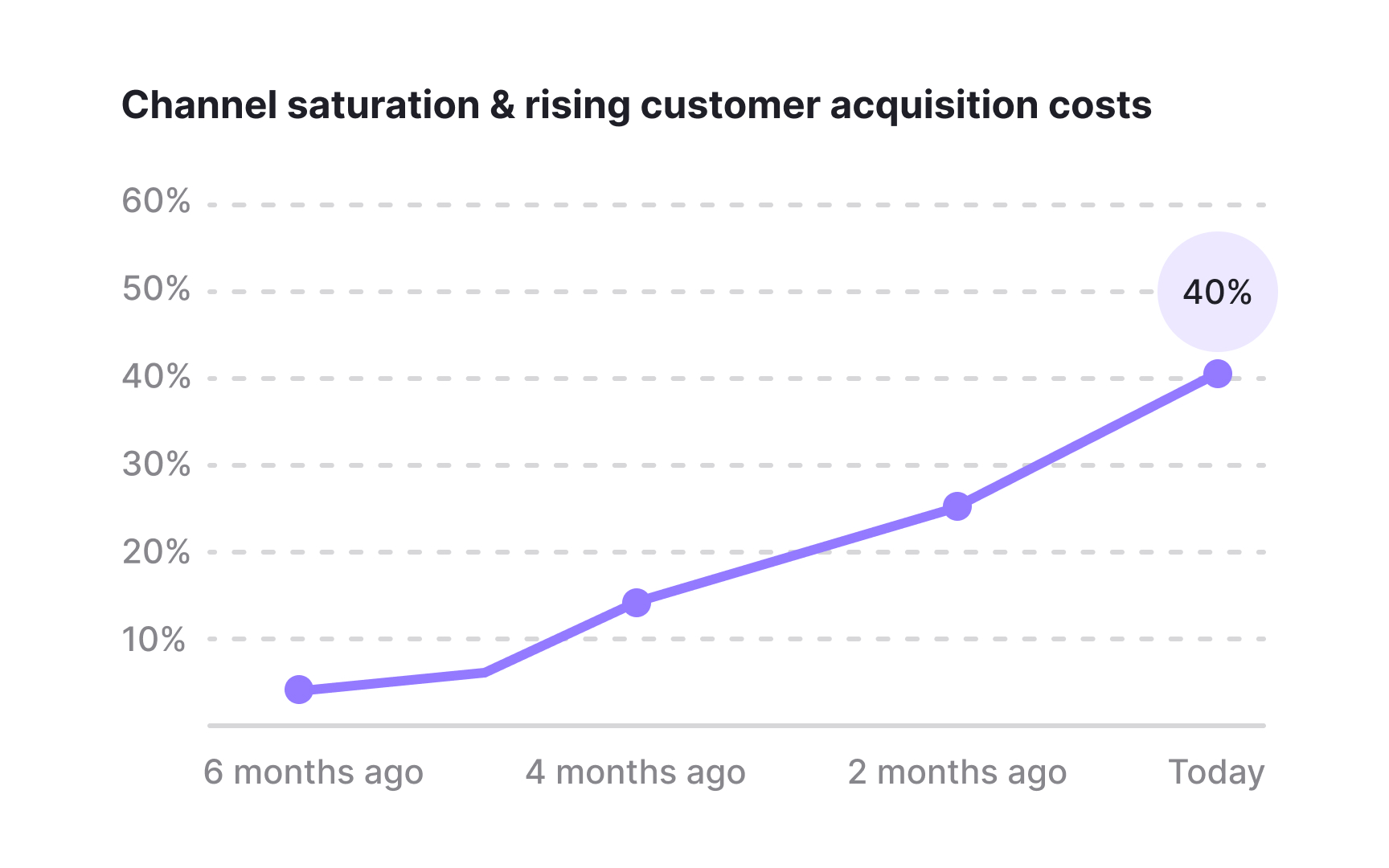
Channel saturation is a structural reality every growing company eventually faces. A channel that generated customers efficiently at 50 accounts will perform differently at 500. As companies scale, they exhaust the most accessible audiences first. Paid search captures the highest-intent searchers early. Content marketing reaches those most likely to engage with written material. Over time, each additional customer through the same channel typically costs more to acquire. This doesn't mean abandoning channels showing degraded efficiency. It means understanding that a channel's economics will shift and not treating early performance as a permanent baseline. The right response isn't to immediately add a new channel. Firstly, diagnose whether efficiency is declining because the channel is genuinely exhausted or because execution has drifted. A drop in paid search might reflect rising bid competition or messaging that no longer resonates. A decline in content leads might mean the topics covered no longer match what buyers search for. Distinguishing structural saturation from fixable execution problems determines whether the right move is diversification or optimization.[8]
Topics
References
- From Zero to IPO: How Growth Needs to Evolve at Every Startup Stage | First Round
- The Art of Marketing Channel Strategy: Maximising Impact and ROI | Growth Method
- The 8 Marketing Channels Every Startup Should Know (And How to Pick the Right One) — Boundless Marketing Co. | Boundless Marketing Co.
- B2B Marketing Channels: Discovery & Prioritization | OpenView Labs | OpenView
- Channel Strategy: How to Choose the Right Marketing Channels for Your Business
- From Zero to IPO: How Growth Needs to Evolve at Every Startup Stage | First Round
- Marketing Channels: A Starter Guide to Prioritizing, Investing, & Optimizing | Reforge Blog
- Marketing Channels: A Starter Guide to Prioritizing, Investing, & Optimizing | Reforge Blog