.svg)

Modern product organizations distribute responsibilities across specialized roles, each with distinct accountabilities. This specialization allows teams to scale effectively, but creates confusion when titles overlap or vary between companies. Understanding who owns what prevents duplicated effort, dropped responsibilities, and frustrating misalignments that slow teams down. Role clarity becomes especially important during cross-functional collaboration. When engineers need to make decisions about technical trade-offs, they need to know whether to approach the product manager, technical product manager, or engineering manager. When stakeholders want to change priorities mid-sprint, understanding the difference between the product owner and scrum master determines how the request gets handled. When joining a new team or company, recognizing how roles map to familiar patterns helps you navigate the organization quickly. The challenge is that companies implement these roles differently. Some combine the product manager and product owner into one position. Others split them strictly. Some organizations have lead PMs as senior individual contributors, while others use that title for people managers. These variations make it essential to understand the core purpose each role serves, allowing you to adapt regardless of how your specific organization structures its teams.
Product manager
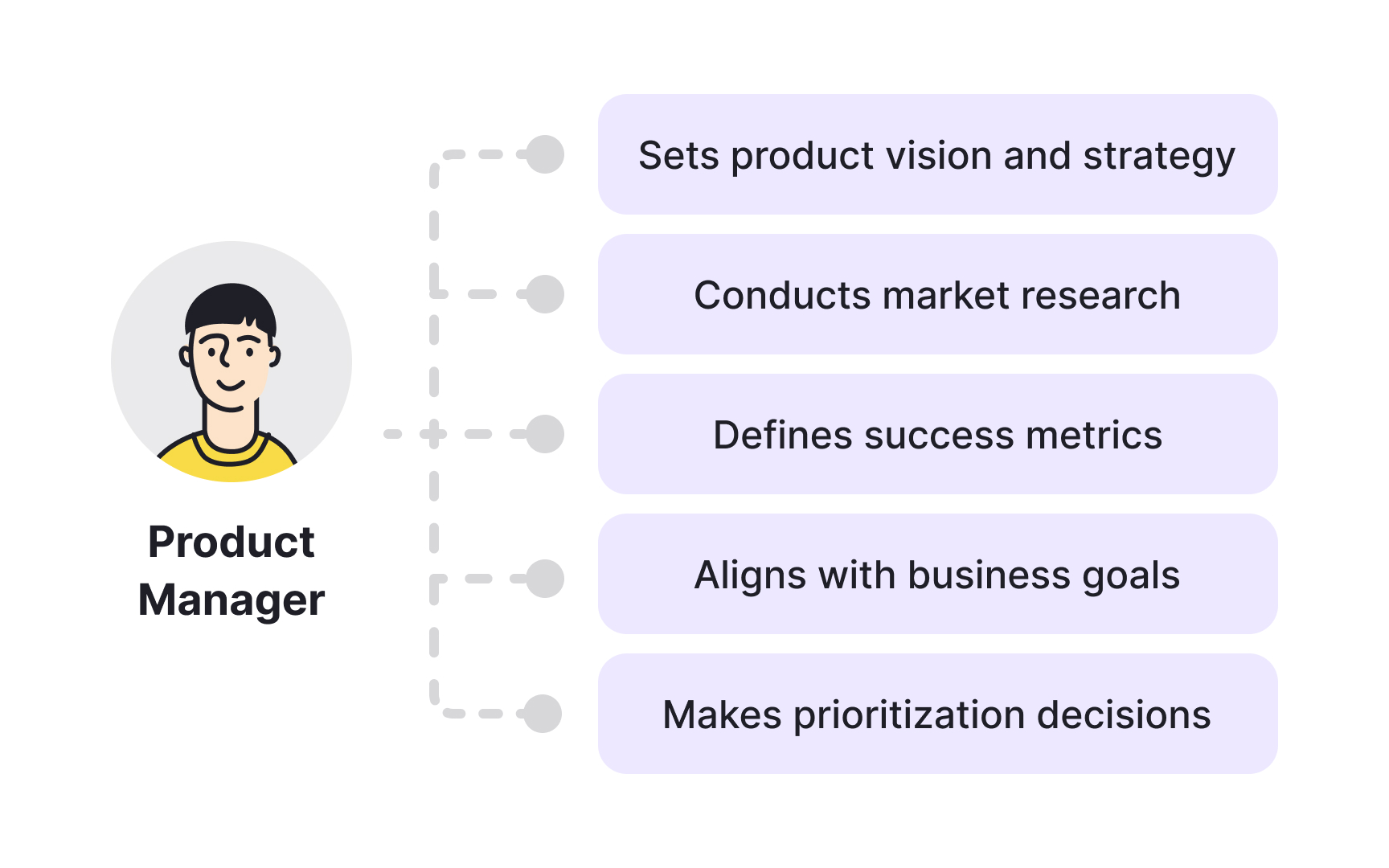


The product manager’s role sits at the intersection of business, technology, and user experience, balancing competing needs to deliver value. Product managers research markets, talk to users, analyze competitors, and identify opportunities worth pursuing. They decide what problems to solve based on impact and strategic fit.
Product managers define success by setting goals and metrics. They align product strategy with company objectives, ensuring their product contributes to business outcomes. They prioritize which features to build first, delay, or abandon, weighing customer needs, technical constraints, and resources.
Their work extends beyond requirements. They communicate vision to stakeholders, rally teams around goals, and measure results after launches. In Agile organizations, product managers set long-term strategy while product owners handle daily backlog management. In smaller companies, one person fills both roles. Product managers think strategically about the entire product lifecycle, from conception through launch and beyond.[1]
Pro Tip! In organizations with both roles, product managers handle outward-facing responsibilities like market research while product owners focus inward on development team collaboration.
Agile product owner
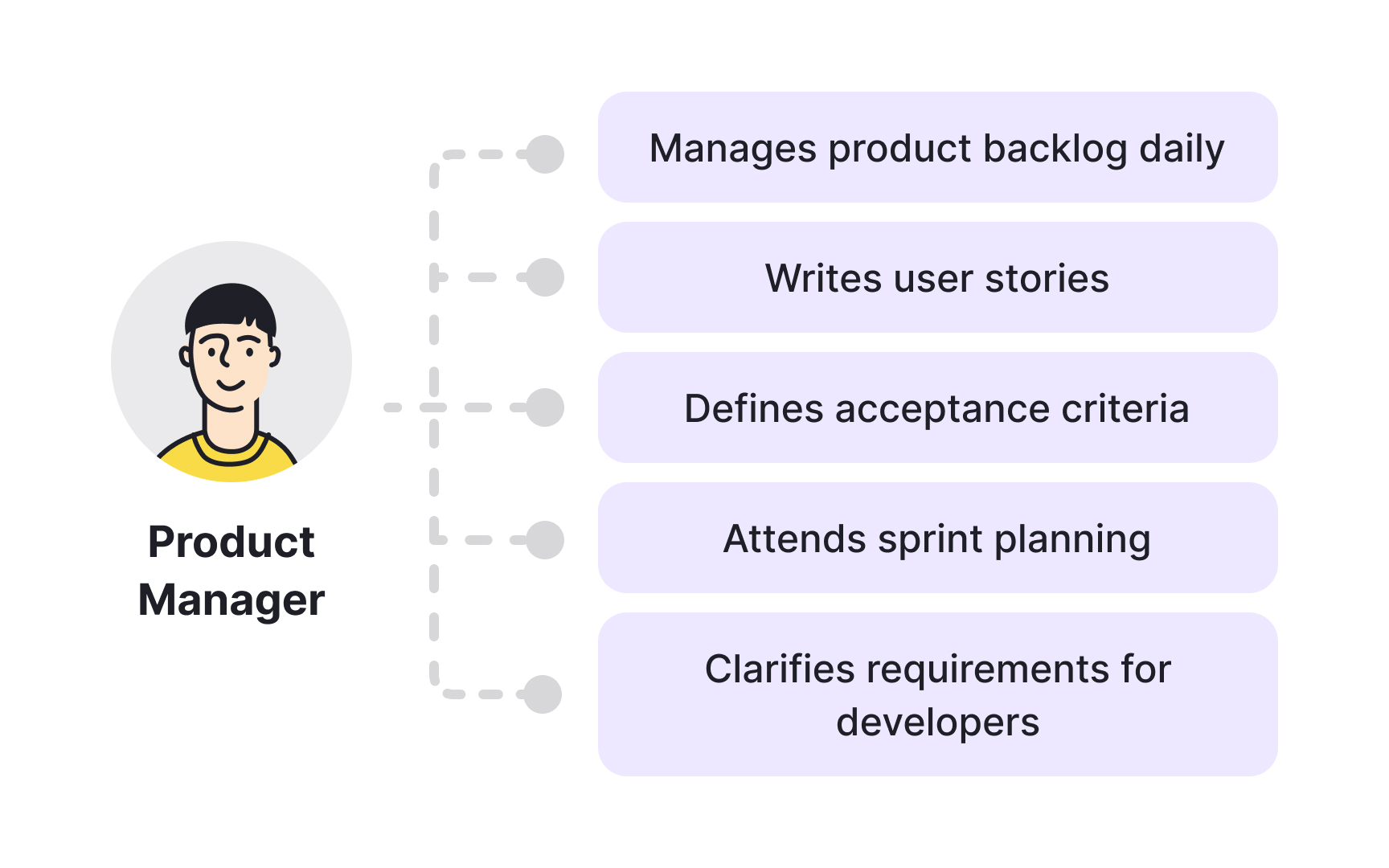
The product owner manages the product backlog and maximizes value delivered by the development team. Essential in Scrum, this role serves as the single voice for what the team builds and in what order. Product owners maintain a prioritized backlog, ensuring valuable features get built first. They write or oversee user stories describing functionality, define acceptance criteria, and determine when work is complete.
During sprint planning, product owners collaborate with developers to select work for the upcoming sprint. They clarify requirements, answer questions, and help the team understand why features matter. Throughout the sprint, they remain available to provide context. At sprint reviews, they assess whether completed work meets criteria and is ready for release. The product owner balances stakeholder demands with team capacity and technical constraints. When stakeholders want different features, the product owner weighs priorities and makes the final call. They participate in backlog refinement, breaking large initiatives into smaller pieces completable within a sprint.[2]
Pro Tip! Product owners make decisions about priority, but the development team decides how much work they can complete in each sprint based on their velocity.
Technical product manager
Technical product managers specialize in products with significant technical complexity, requiring a deep understanding of engineering systems and architecture. Unlike traditional PMs who focus on market needs, technical PMs bridge business requirements and technical implementation. They understand how systems work, discuss architecture trade-offs with engineers, and assess technical feasibility.
This role commonly appears in companies building developer tools, APIs, data platforms, or infrastructure. Technical PMs work closely with engineering to define technical requirements, evaluate architecture options, and ensure solutions are scalable. They can read code, understand system diagrams, and participate meaningfully in technical discussions without writing production code. Technical PMs translate between technical and business stakeholders. When engineers propose new frameworks, technical PMs explain implications for timelines, user experience, and outcomes to non-technical leaders. They also translate business requirements into technical specifications that engineers can implement.[3]
Pro Tip! Technical product managers don't necessarily write production code, but they understand system architecture well enough to assess feasibility and guide technical decisions.
Lead product manager
Lead product managers are senior individual contributors who own significant product areas while mentoring less experienced PMs. This role represents the next step beyond product manager, recognizing strategic impact and leadership capability. Lead PMs manage more complex products, handle higher-stakes decisions, and take on responsibilities beyond their own scope. The lead PM role includes:
- Mentoring junior product managers, reviewing their work, and helping them develop skills.
- Providing guidance on prioritization, stakeholder management, and strategy.
- Representing the product organization in high-level discussions and presenting roadmaps to executives
- Driving cross-functional initiatives spanning multiple products or teams
- Establishing processes, creating templates others can use, and championing best practices
While they don't manage people directly, they influence product direction and serve as experts for complex questions. This role provides career growth for talented PMs without requiring them to become people managers.[4]
Product marketing manager
Product marketing managers bridge product development and market success by owning positioning, messaging, and go-to-market strategy. Unlike product managers who focus on building the right product, product marketing managers focus on how to sell it. They translate features into customer benefits and ensure the market understands why the product matters. Product marketing managers’ responsibilities include:
- Conducting market research to understand customer needs, competitive landscape, and trends
- Creating buyer personas
- Identifying target segments
- Determining positioning against competitors
This research informs messaging frameworks that sales teams use with prospects, answering: what makes this product different, who should care, and why choose it over alternatives. Go-to-market execution is central to this role. Product marketing managers perform the following:
- Planning launches
- Coordinating with PR and content teams
- Creating sales materials like presentations and demo scripts
- Training sales teams on pitching
After launch, they track metrics, gather feedback, and refine messaging. Success requires communication skills, market intuition, and working across marketing, sales, and product teams.[5]
Scrum master
The scrum master facilitates the Scrum framework, ensuring teams follow Agile principles and continuously improve. This role is neither a manager nor a decision-maker but a team-focused facilitator who coaches teams toward self-organization. Scrum masters create environments where teams do their best work by removing impediments, facilitating meetings, and promoting Agile values. Scrum masters facilitate key ceremonies, including sprint planning, daily standups, sprint reviews, and retrospectives. They ensure meetings stay focused, time-boxed, and productive. During planning, they help teams break down work and commit to realistic goals. In standups, they watch for blockers. At retrospectives, they guide teams to identify improvements without dictating solutions. A critical responsibility is protecting the team from interruptions and helping them maintain a sustainable pace. If stakeholders try to add work mid-sprint, the scrum master explains why this disrupts team commitment. If unclear requirements slow progress, they help the product owner clarify. Success comes from the team's growing ability to self-manage and improve.[6]
Program manager

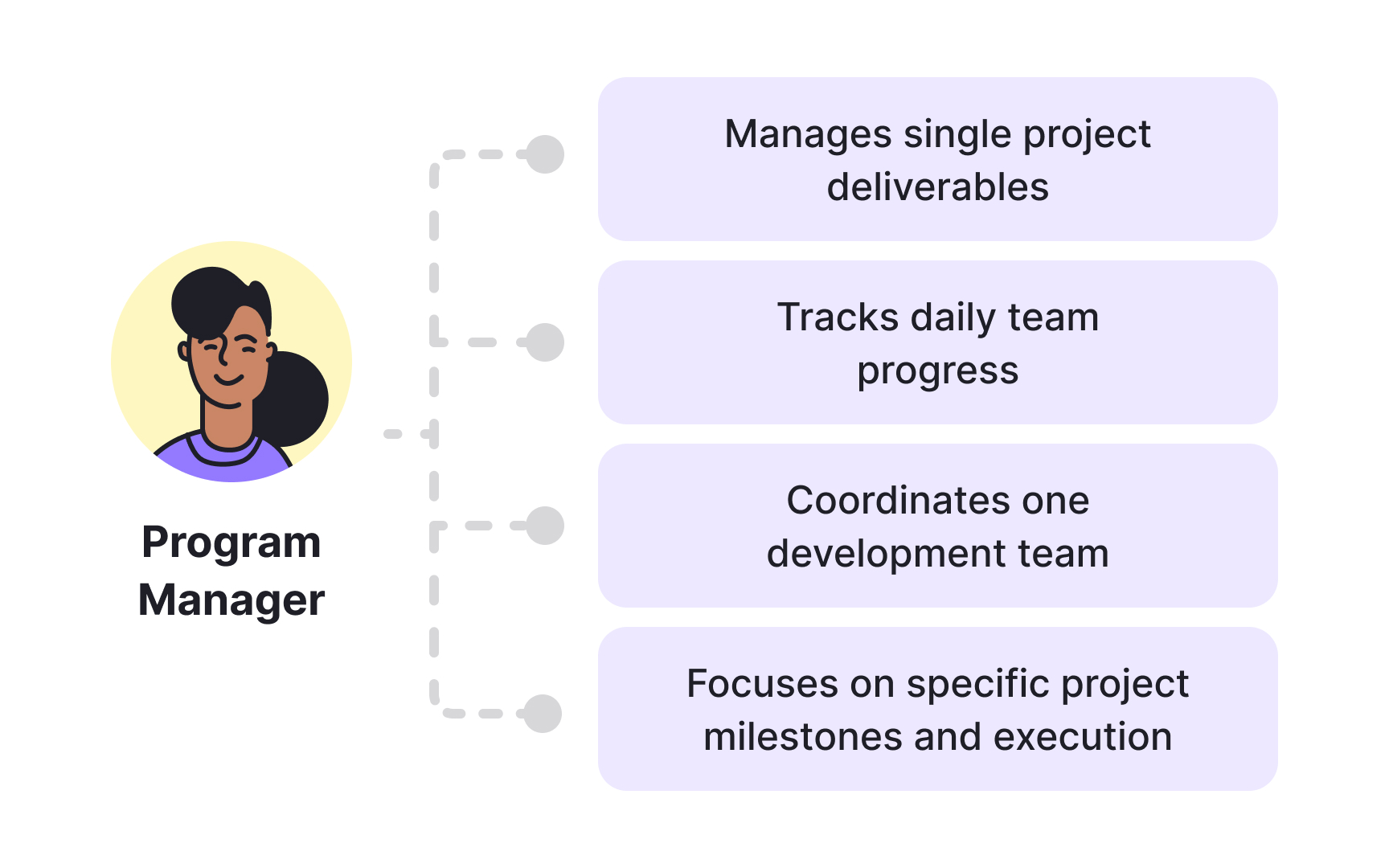
Program managers coordinate multiple related projects or products to achieve broader business objectives. While product managers focus on individual products and project managers handle single initiatives, program managers orchestrate work across teams toward common goals. This role appears in large organizations with complex, interdependent work streams.
Program managers create coordination frameworks that help teams work effectively. They identify dependencies between projects, ensure teams communicate about shared needs, and escalate risks. When one team's delay affects others, the program manager resolves the bottleneck. When products need similar functionality, the program manager facilitates collaboration.
The program manager's work emphasizes process, communication, and risk management over product strategy. They maintain program roadmaps showing how projects contribute to objectives, track progress, and report status to executives. They manage budgets, allocate resources, and ensure teams have what they need. Success requires organizational skills, seeing connections others miss, and bringing diverse groups together.[7]
Engineering manager
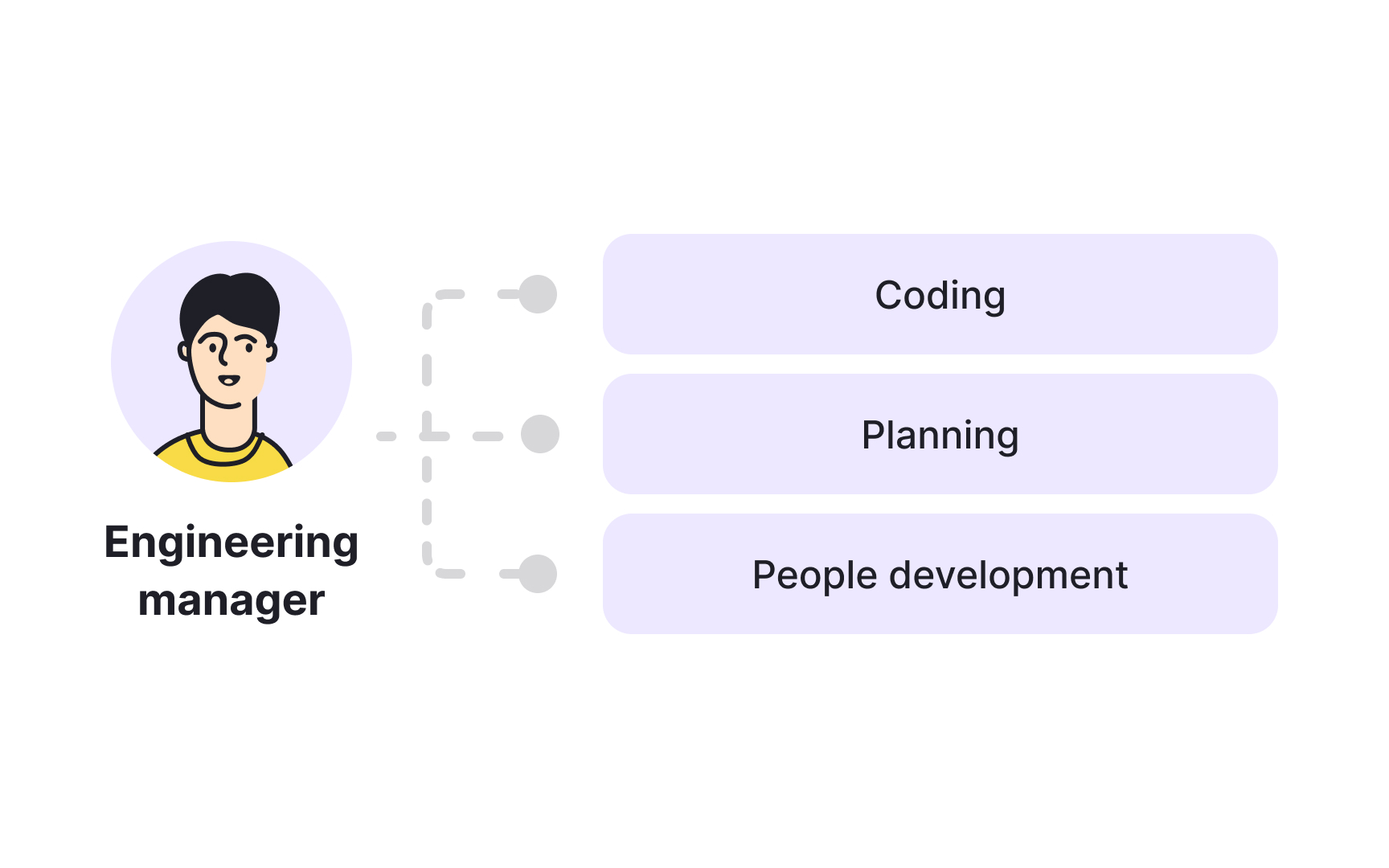
Engineering managers lead software development teams, balancing people management with technical leadership. Unlike scrum masters who facilitate process, engineering managers make hiring decisions, conduct performance reviews, and are accountable for technical output. They ensure engineers have support, skills, and resources to build quality products efficiently. Engineering managers split time between coding, planning, and people development. They participate in architecture discussions, review code, and sometimes write code. They translate business requirements into technical approaches, estimate effort, and make trade-offs between speed and quality. When technical debt accumulates, they decide when to prioritize fixes.
The people management aspect requires different skills. Engineering managers conduct one-on-ones to understand career goals, provide performance feedback, and help engineers grow. They handle team dynamics, resolve conflicts, and maintain a healthy culture. When working with product managers, they represent technical constraints and capacity. They push back on unrealistic timelines while committing to deliver.[8]
Topics
References
- What is a Product Owner? | Scrum.org
- Understanding the Technical Product Manager Role and Responsibilities - Bristow Holland | Bristow Holland
- Product Manager: Role & Best Practices for Beginners | Atlassian
- What Is a Product Marketing Manager? Job Description and Salary
- What is a Scrum Master? | Atlassian
- Program Manager | ProductPlan
- What Does an Engineering Manager Do: Roles And Responsibilities - GeeksforGeeks | GeeksforGeeks