

.svg)

Most product teams spend their planning cycles ranking features. Senior PMs know that the more important question is where to place bets with headcount and time. Resource allocation is not a backlog exercise. It is a strategic decision about which outcomes the organization is willing to fund, and which ones it is willing to let die.
The difference matters because feature ranking assumes a fixed set of options and asks which ones to prioritize. Portfolio thinking asks whether the options themselves are the right ones. A team betting two squads on retention and one on expansion is not just organizing work differently. It is making a judgment about where the growth will actually come from, and funding that judgment with real engineering capacity. This lesson covers the frameworks PMs use to make those bets well: how to distinguish good strategy from a list of wishes, how to avoid the trap of spreading resources too thin across too many priorities, how to balance protecting today's revenue engine with funding tomorrow's growth, and when copying competitors is the smart move versus when it gives away your advantage.
What makes a strategy real
The word "strategy" gets applied to almost everything in product management. Roadmaps get called strategic. OKRs get called strategic. Prioritization frameworks get called strategic. Most of them are not. A priority list is not a strategy. A vision statement is not a strategy. A strategy is a diagnosis of a specific challenge, a governing policy for how to address it, and a set of coherent actions that follow from that policy.
The clearest test of whether a strategy is real comes from what it excludes. A strategy that does not explicitly say what the team is not doing is not a strategy. It is a wish list. Saying "we will focus on enterprise growth, mid-market expansion, and consumer adoption" is not a strategic choice. It is three strategies competing for the same resources, which means none of them will be executed well. The practical implication is that writing a good strategy is an act of saying no. The team that can articulate "we are building for enterprise buyers and deliberately ignoring the self-serve consumer segment for the next 18 months" has a strategy. The team that wants to serve everyone has a roadmap with too many items on it.[1]
Pro Tip! If your strategy document does not make anyone uncomfortable, it probably is not a strategy. Real strategic choices cut something someone cares about.
Allocate teams like an investment portfolio
Feature prioritization and resource allocation look like the same problem, but they are not. Ranking backlog items is a list management exercise. Deciding how many teams work on which problems is a strategic bet. When a PM ranks features, they are managing a list. When a PM allocates teams to outcomes, they are managing a portfolio of bets.
The portfolio framing changes how decisions get made. Instead of asking "should we build Feature X or Feature Y?", the question becomes "how many teams should we bet on retention versus expansion this quarter?" A team allocated to a retention outcome can discover that the specific feature they planned to build does not work, pivot to a different solution, and still succeed without needing to go back to leadership for re-approval. The outcome was funded. The output was left flexible.
This is what empowered product teams actually means in practice. The team is not handed a list of things to build. They are handed a problem to solve and trusted to find the best way to solve it. Resource allocation that funds outputs locks teams into solutions. Resource allocation that funds outcomes gives them room to do real discovery.[2]
Avoid the peanut butter trap
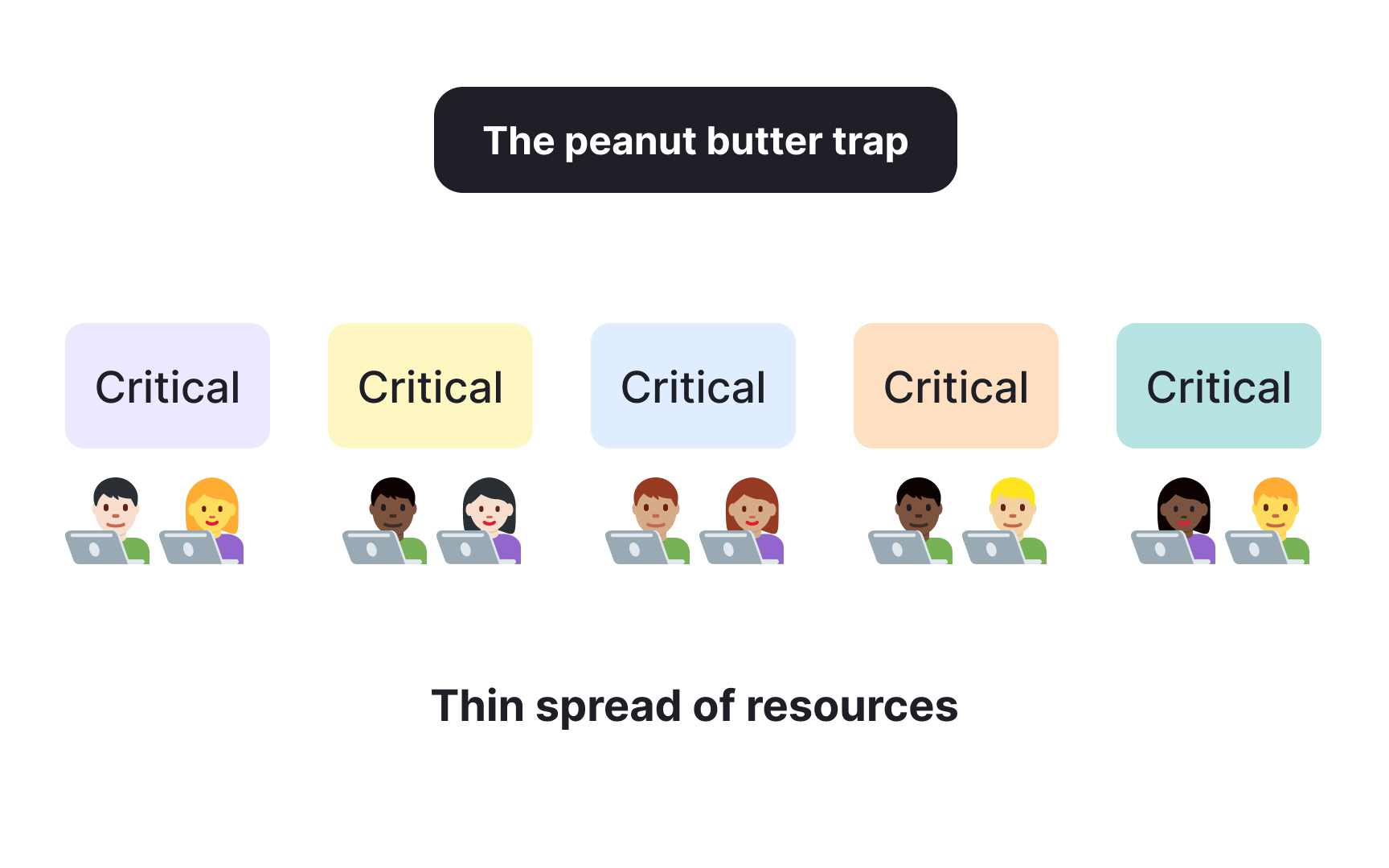
The peanut butter trap is one of the most common failure modes in product strategy. It gets its name from the way resources get spread: thin, smooth, and equally across everything. A team running 5 priorities with 2 engineers each is not executing a strategy. It is hedging against having to make a choice, and the result is that nothing gets enough investment to move meaningfully.
The trap is appealing because it feels fair. Every stakeholder gets something. No one has to hear that their priority was deprioritized. But the math does not work in the team's favor. The returns on effort in product development are not linear. A team of 2 working on a problem for a quarter is not half as effective as a team of 4. In most cases, underfunded initiatives produce no meaningful outcome at all, which means the resources were spent without generating any return.
The antidote is not ruthless prioritization for its own sake. It is honest accounting. Before committing to a priority, the team should ask: "Do we have enough capacity to actually move this?" If the answer is no, putting it on the roadmap is not a commitment. It is a distraction dressed up as a plan.[3]
Balance short and long-term bets with horizon planning

Horizon planning divides work into 3 categories, each with a different risk profile and a different standard for success:
- Horizon 1 covers the existing business: the products, features, and revenue streams that are working right now. Around 70% of the effort typically belongs here.
- Horizon 2 covers adjacent bets, taking existing capabilities to new markets or bringing new capabilities to existing customers. A reasonable allocation is around 20%.
- Horizon 3 covers the long-range bets, the experiments that might define the next version of the company, or might fail entirely. Around 10% of the effort lives here.
The framework is most useful because of a rule it makes explicit: do not judge H3 bets with H1 metrics. A Horizon 3 project in 3 months of development will have low revenue, uncertain product-market fit, and no clear ROI. That is not a sign that the project is failing. That is what early-stage discovery looks like. Organizations that apply their core business performance metrics to experimental bets tend to kill their own future before it has time to develop.
Practically, this means treating each horizon as a separate investment thesis with its own success criteria. H1 is measured on efficiency and retention. H2 on growth and expansion. H3 on learning and validated hypotheses.[4]
Decide when to copy competitors and when to differentiate
Not every product decision is a chance to innovate. Some features exist because users expect them, not because they create a competitive advantage. The ability to distinguish between parity features and differentiation features is one of the more underrated skills in product strategy:
- Parity features are the things a product must have to stay in the consideration set. Login flows, settings pages, billing management, and basic integrations: users do not choose a product because of these. But they will eliminate a product from consideration if these features are missing or broken. The right strategy for parity features is to copy fast, use standard patterns, and spend as little design and engineering effort as possible. Reinventing a login flow is not a competitive advantage. It is an expensive way to solve a problem that has already been solved.
- Differentiation features are the opposite. These are the reasons users choose a product over the alternatives, and they deserve the team's best design and engineering investment.
- Pivot: Most startups begin as a point solution focused on a narrow problem to gain traction, then evolve into a platform to build durability. During that transition, new capabilities often start as parity features, and misallocating senior talent to polish them is a common mistake.
The trap is spending differentiation-level effort on parity problems, and parity-level effort on the things that are supposed to make the product genuinely better. Getting the distinction right means the team can focus its creative energy where it will actually move the needle.[5]
Pro Tip! Ask: "Does this feature make users choose us, or does it just stop them from ruling us out?" The answer determines how much effort it deserves.
Platform vs. point solution trade-offs

One of the biggest strategic choices a product team makes is not about which feature to build next. It is about what kind of product they are building at all:
- A point solution solves one specific problem very well. It is fast to build, easy to explain, and tends to generate strong early adoption. The limitation is that point solutions are easy to replicate. A competitor can observe what you built, copy the core functionality, and launch a version within a product that already has more users. Point solutions have low defensive moats.
- A platform is different. Instead of solving one problem, a platform creates the infrastructure for others to solve many problems, either by connecting users to each other, enabling third-party developers to build on top, or generating network effects that make the product more valuable as more people use it. The names that have survived in technology, Salesforce, iOS, and Microsoft, have done so largely because their platform architectures make switching costs extremely high.
The catch is that platforms are extremely difficult to start. They face what is called the cold start problem: a platform is not useful until it has enough participants to generate network effects, but it is hard to attract participants until the platform is already useful. Most successful platforms started as point solutions, built a critical mass of users around a specific problem, and then expanded the platform layer once the network was large enough to sustain it.[6]
Diagnose a weak strategy document
Knowing the difference between parity and differentiation features is useful as a taxonomy. The real payoff comes when it drives resource allocation decisions. Most teams distribute engineering and design capacity across their backlog without asking whether a given feature deserves their best people or their fastest execution. The result is a team that spends senior design talent on a settings page and ships a core differentiator with two weeks of effort.
The discipline is to match the investment level to the feature type deliberately:
- Parity features have a budget: the minimum effort required to meet user expectations without embarrassing the product.
- Differentiation features have a different mandate: the maximum effort the team can justify, because this is where competitive distance gets built.
When a PM maps their roadmap against this split, it often reveals that the team has been doing the opposite, over-investing in table stakes and under-investing in the things that actually drive choice.
This connects directly to the peanut butter problem. Spreading resources evenly across a backlog treats all features as equally important. Sorting by parity versus differentiation first gives the team a principled reason to concentrate effort, and a defensible answer when stakeholders push back on why certain items are receiving more investment than others.