


.svg)

Most founders have a mental picture of their target customer. It tends to be too broad, too demographic, and almost entirely disconnected from how that person actually makes purchasing decisions. "Small businesses" is not a customer. "28-to-35-year-old marketing managers" is not a customer either. A customer is a specific person with a specific problem who makes decisions in a specific context, and understanding that context changes everything about how you sell.
The type of customer you are selling to, whether a consumer making a solo decision in an afternoon, a small business owner consulting a manager, or a corporate procurement team working across six months, shapes your sales motion, your pricing model, your channels, and how you communicate value. Getting this wrong does not just slow things down. It puts you in the wrong conversation entirely.
Then there is the buying journey itself. Marketing diagrams show a tidy funnel where customers move smoothly from awareness to purchase.
Customer types and what they mean for your sales motion
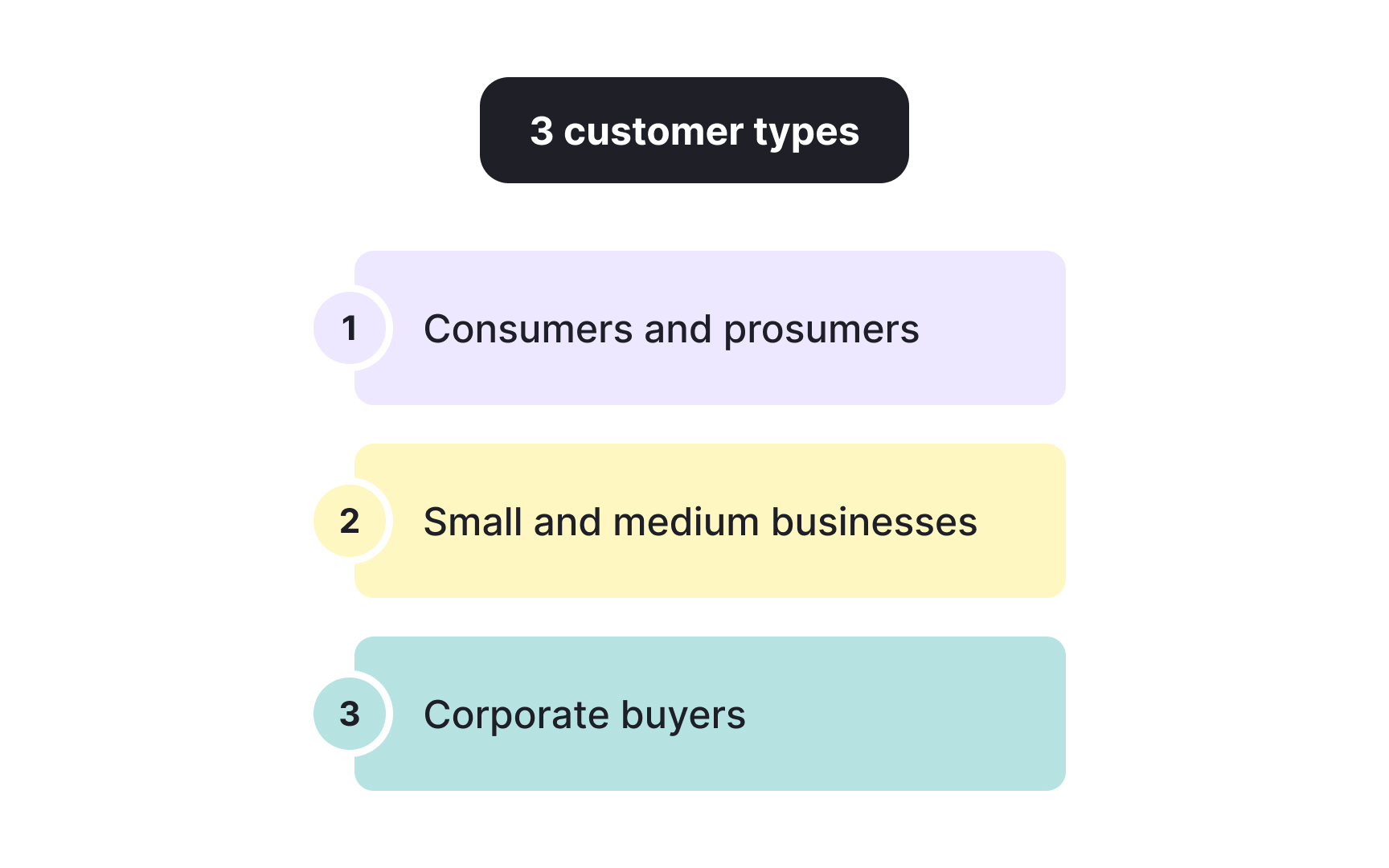
Not all customers buy the same way. A consumer can decide in a day. A corporate procurement team evaluating the same product category may take 18 months. That gap is not just time. It is about who is involved, what they need to feel confident, and what sales motion is required.
3 customer types shape how you sell:
- Consumers and prosumers make fast, personal decisions with their own money, so the product does the selling. Self-serve onboarding and freemium models exist for this group because a human sales conversation costs more than the purchase is worth.
- Small and medium businesses take weeks to months. An owner, a manager, and sometimes a finance contact are involved. A blend of product experience and light sales support works here.
- Corporate buyers run on different terms. Sales cycles span 6 to 18 months. A business sponsor, an end-user, a procurement team, and often a legal team are all involved. Ticket size is large, volume is low, and the motion is relationship-driven and consultative.[1]
B2B, B2C, B2G, and B2B2C business model differences
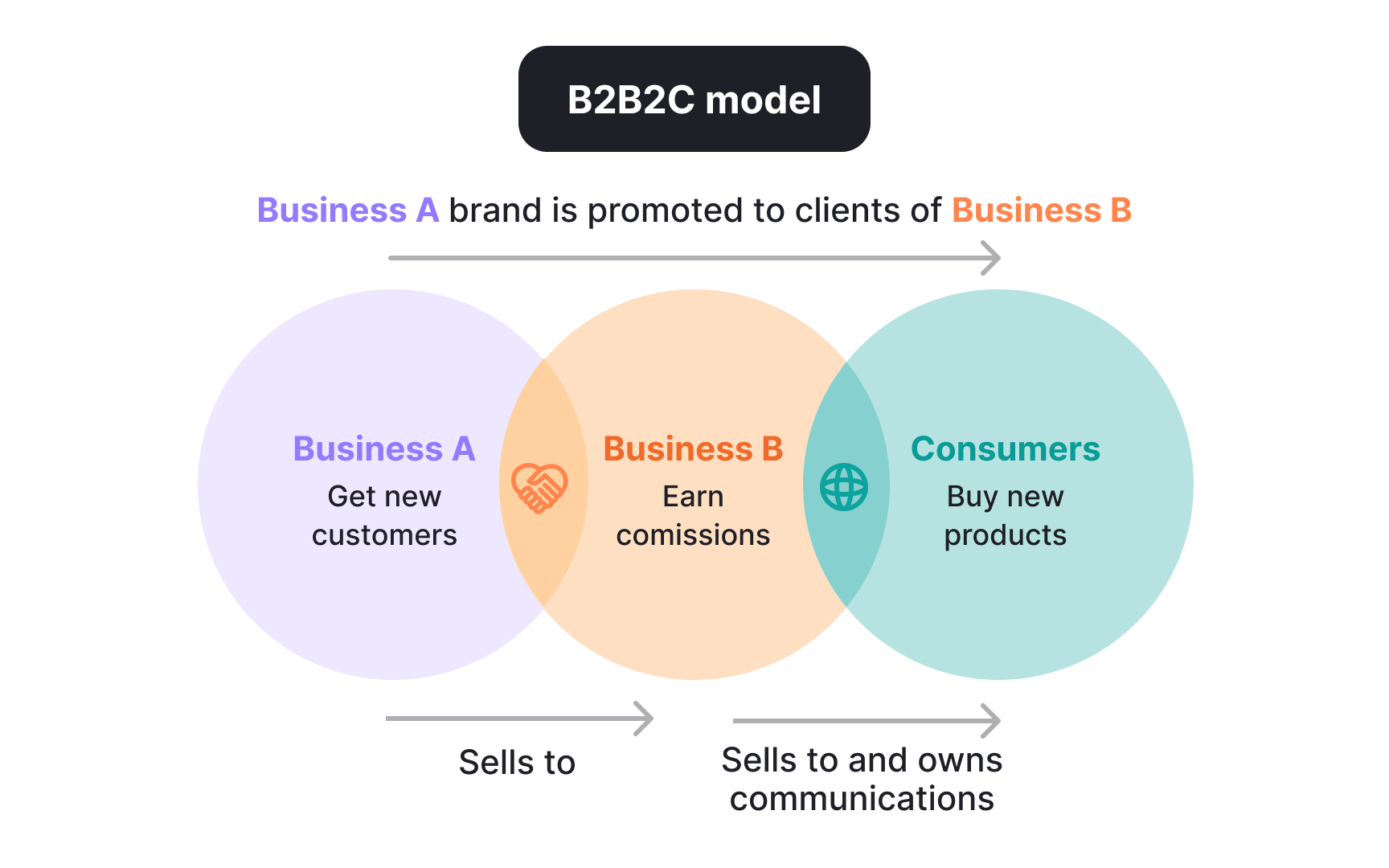
The customer type you sell to is one dimension of go-to-market, but so is the structure of the relationship. B2B, B2C, B2G, and B2B2C each describe different regulatory environments, decision dynamics, and expectations about how relationships work:
- B2B: means selling to another business. Contracts are formal, buyers are cautious, and decisions involve procurement teams, legal review, and multiple sign-offs. But underneath all of that process is a person with a career and a reputation on the line. That person wants to know the decision will look good, not just that the paperwork is correct.
- B2C: means selling directly to consumers. Volume is your friend, acquisition economics must stay lean, and the product experience is the primary sales tool. The gap between a good product and a failed one often shows up in the first few minutes of use.
- B2G: means selling to the government. Formal tenders, compliance requirements, and extended payment terms make most direct sales approaches unworkable. Even here, a person is reading the proposal and forming a judgment.
- B2B2C: describes a model where you sell to a business that then delivers your product to their customers. You manage two relationships simultaneously: the direct buyer, whose commercial needs shape the contract, and the end consumer, whose experience determines whether the direct buyer renews.
Getting both sides of a B2B2C relationship right is the central challenge of that model, and most companies underestimate how much the consumer side drives commercial outcomes.[2]
Pro Tip! Regardless of the model, every sale involves a person making a judgment call. Understanding their personal stake matters as much as understanding the formal process.
How the non-linear customer journey actually works
The funnel is a useful simplification. It is not how buyers actually behave. Real decisions are messy and discontinuous, shaped by factors that have nothing to do with your marketing calendar.
A prospective customer might see your product in a newsletter, do nothing for 4 months, encounter a case study from a colleague, try a trial, abandon it when priorities shift, get a personal recommendation 6 months later, and then buy. That journey involved pauses, backtracking, and timing you did not control. Buyers move on their own timeline. You cannot push them through your stages. What you can do is reduce friction, stay visible and credible, and make it easy to pick up where they left off when they are ready.
If you measure success only by a linear path from first touch to close, you will misattribute what is actually driving conversions. A deal that closed from a post 8 months ago does not show up clearly in a last-touch model. The investment that actually drove the decision becomes invisible.[3]
Pro Tip! A prospect who went quiet 6 months ago is not lost. They may just be waiting for internal conditions to change.
The 8 stages of the customer journey
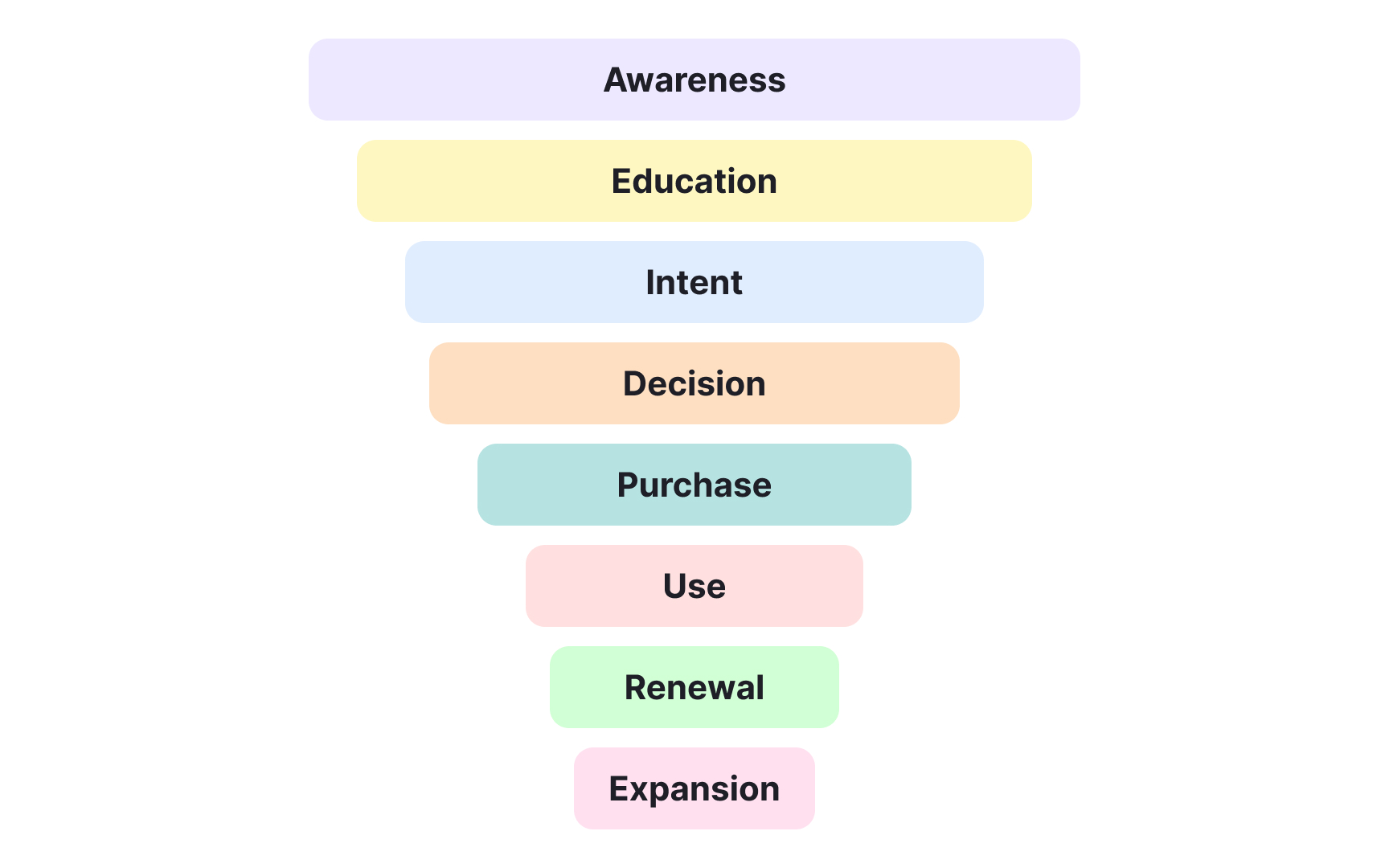
While the customer journey is non-linear, there are recognizable stages most buyers pass through. Understanding each one helps you identify where your marketing, sales, and product are doing their job and where people are quietly dropping out.
- Awareness: customers learn your product or category exists through advertising, word of mouth, search, or direct outreach.
- Education: customers begin to understand what the product does and whether it applies to their situation. They are not close to buying. They are making sense of what they found.
- Intent: something shifts. A project starts, a pain point becomes urgent, or a budget opens. Passive awareness becomes a purposeful search.
- Decision: active evaluation. Demos happen, reviews get read, references get called. Buyers are narrowing down to a choice. This stage looks different depending on who is buying — an enterprise team runs formal evaluations over weeks, while a consumer picks up a product, thinks "I just don't feel like it," and puts it back. Both have just moved through the same stage, one with a procurement checklist and one with a gut feeling.
- Purchase: the transaction. Not the end of the journey.
- Use: value is created or destroyed here. Customers’ experience in their real workflow, with their actual constraints, determines what follows.
- Renewal: for subscription businesses, a new decision point. Problems in the use stage surface here.
- Expansion: customers who grow their usage, add seats, or buy additional products signal that the product delivers more value than it costs.[4]
Pro Tip! The stages are universal. What differs between customer types is how visibly they play out, not whether they exist.
Align your go-to-market with how buyers experience each stage
Your CRM categories and your buyers’ experience are not the same thing. Internally, you track leads, trial users, and opportunities. Externally, buyers are trying to solve a problem. Building your motion around internal categories instead of buyer experience creates friction at every stage:
- At Awareness, your job is to be findable and credible. The customer is deciding whether to pay attention, not evaluating you yet.
- At Education, your job is clarity. Complicated positioning and friction-heavy sign-up flows lose people before they ever experience the product.
- At Intent and Decision, your job is to reduce risk. Case studies, clear implementation information, and responsive sales engagement address the anxiety that drives hesitation.
- At Use, your job is to deliver the value you promised. Fast time-to-value and product features that fit the customer's real workflow matter more than messaging here.
- At Renewal and Expansion, your job is to surface the value customers have already received and make the case for continued and growing investment.[5]
Pro Tip! Education, Intent, and Use get the least investment, yet they are where most deals are actually won or lost.
Recognize when the customer perspective and the company perspective diverge
The same interaction looks different depending on whether you are the buyer or the seller. A founder running a demo sees a prospect moving through a pipeline stage. The prospect sees a vendor presentation while managing 3 other priorities, waiting for an internal conversation that has not happened yet.
When you build your motion around how you track customers rather than how customers experience their journey, you optimize the wrong things.
Follow-up timing is a clear example. A prospect who went quiet after a demo looks stalled from a sales perspective. From the buyer's side, the silence means the internal conversation has not happened yet. Pushing follow-ups into that silence is one of the most reliable ways to lose deals that were still in play. Understanding the customer's perspective requires active listening, honest post-mortems on lost deals, and genuine curiosity about what is happening on the buyer's side. The sales team that knows why each prospect went quiet is far better positioned than the one that treats silence as just another pipeline stage to move past.[6]
Pro Tip! Post-loss calls with prospects who chose a competitor reveal more about your real journey gaps than any win review will.
Identify the conversion metric at each journey stage
Every journey stage has a moment of transition. The customer either moves forward or they do not. Measuring whether that transition is happening, and at what rate, turns a theoretical journey map into a diagnostic tool.
- Awareness to Education: what proportion of people who encounter you take the next step, such as visiting your site or starting a trial? A low rate points to targeting problems, weak messaging, or too much friction in the first action you ask for.
- Education to Intent: how many people engaging with your content show genuine purchase signals, such as booking a demo or requesting pricing? Problems here often reflect a mismatch between the audience you attract and the audience that actually buys.
- Intent to Purchase: your close rate. Problems here point to sales process issues, pricing mismatches, or gaps between what the product promises and what it demonstrates during evaluation.
- Purchase to Renewal: your retention rate. Churn at this stage tells you the product is not delivering the value customers expected when they bought it.
- Renewal to Expansion: whether satisfied customers grow their usage or buy additional products. Expansion revenue is the clearest signal that customers are finding increasing value over time.[7]
Spot the funnel-forcing mistake
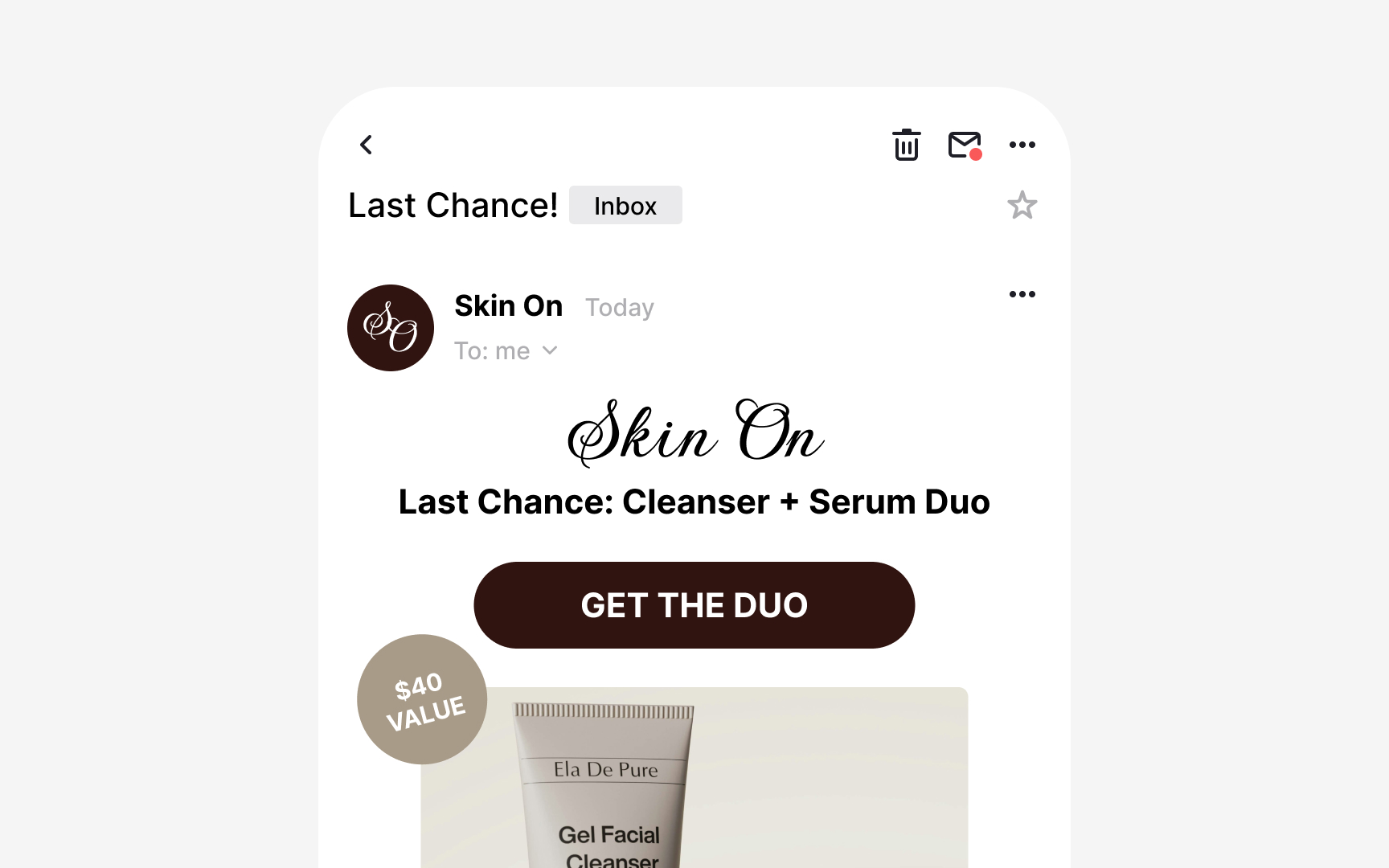
Funnel-forcing is what happens when a go-to-market team designs its outreach around the company's schedule rather than the buyer's readiness. Emails go out because a certain number of days have passed, not because the buyer did anything. Onboarding nudges push users toward milestones that matter to the company's metrics, not to the user's actual workflow.
The underlying assumption is that you control the pace of the buyer's journey. You do not. A buyer who has not yet had the internal conversation that makes a purchase possible is simply not ready, and a 5th follow-up email does not change that.
Funnel-forcing does not just fail to move deals forward. It actively damages them. A deal that could have closed in 3 months with patient engagement can be lost to 6 weeks of aggressive follow-up, as the buyer was not in a position to act on it.
The alternative is to follow the buyer's signals rather than your calendar. A prospect revisiting your pricing page after 2 months of silence is telling you something. A trial user inviting colleagues is telling you something different. Both are more reliable indicators of readiness than the number of days since their last reply.[8]
Pro Tip! What a prospect does after a demo call tells you more about where they are than anything they said during it.
Apply customer journey thinking to your own business
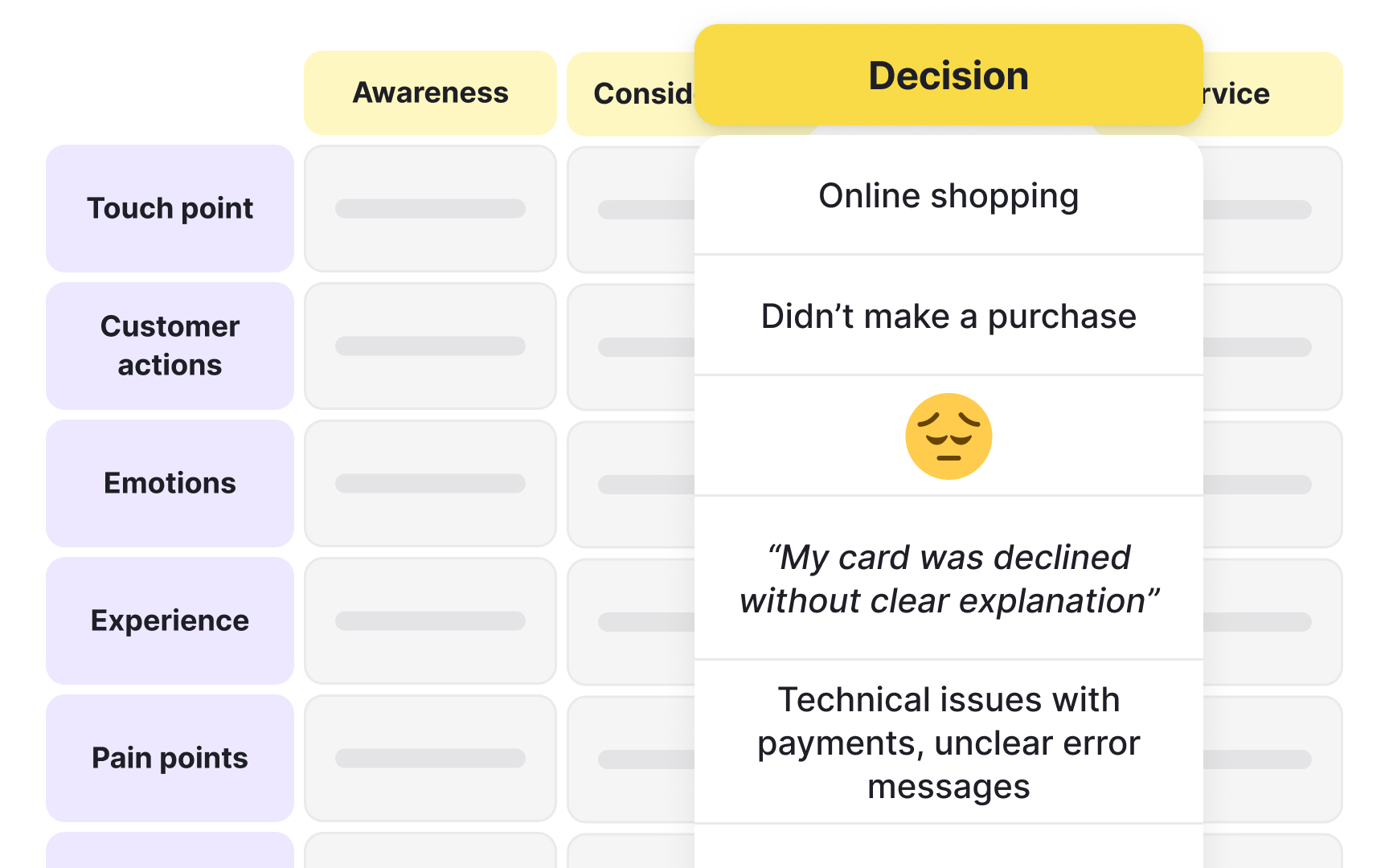
Journey mapping is only useful when built from real data, not assumptions. A founder who maps the journey based on how they imagine buyers behave produces a map that reflects their own mental model, not their customers' reality. That gap is usually where deals are lost without anyone understanding why.
Building an accurate map starts with real conversations. If you have spoken to 20 potential customers, you have data worth analyzing. What was happening when they first felt the problem? How did they find potential solutions? What almost stopped them from buying?
Those answers, collected consistently across multiple conversations, reveal the actual shape of the journey for your specific customer and market. An enterprise compliance buyer has a very different journey than a consumer signing up for a fitness app. The stages are the same. The triggers, timelines, and friction points are entirely different.
Once you have a real journey map, it becomes a diagnostic. You can ask honestly where you are present, where you are absent, and where you are creating friction instead of reducing it. The answers tell you not just what to fix, but in what order.[9]
Pro Tip! Customers who chose a competitor reveal your journey gaps more clearly than your success stories ever will.
Topics
References
- How to choose the right go-to-market motions (+examples)
- The difference between B2B and B2C Go-to-Market | GTM Alliance
- Customer Journeys Aren’t Linear. Your Inbound Flows Shouldn’t Be Either.
- 13 buying signals that indicate purchase intent (and how to act on them) | Outreach
- SaaS Customer Journey Mapping | Twilio
- 13 buying signals that indicate purchase intent (and how to act on them) | Outreach
- SaaS Customer Journey Mapping | Twilio