



.svg)


3D design shows up in more places than most designers realize. Architecture studios use it to walk clients through buildings that do not exist yet. Game studios use it to build entire worlds. Product teams use it to visualize packaging, hardware, and physical goods before a single prototype is made. And increasingly, product designers and web developers are using tools like Spline to add interactive 3D directly to apps and websites, no specialized 3D background required.
The industries using 3D today span animation, film, games, AR and VR, architecture, product design, medical visualization, and spatial computing. Each has its own workflows and software conventions, but the underlying spatial thinking carries across all of them. Blender covers modeling, rendering, and animation, and is free. Cinema 4D is common in motion design and broadcast. For web and UI contexts, Spline is the most accessible starting point.
AI tools are also changing how quickly designers can prototype in 3D. Meshy AI and Luma AI can generate rough 3D models from an image or a text prompt, which makes early-stage exploration much faster. Strong foundational knowledge still matters because generating a model and knowing what to do with it are two different things. Understanding the applications gives you a map. The rest of this course gives you the tools to navigate it.
3D animation

3D animation shapes how stories get told across film, TV, and streaming. It works by building digital models of characters and environments, then rendering them, a process that converts a 3D scene into a flat 2D sequence of images. Artists control light direction and intensity, how shadows fall across surfaces, and reflections that make materials look real. These elements create depth and dimension that 2D animation cannot match.
Toy Story, released in 1995, was the first fully computer-animated feature film and the proof that 3D could carry an entire story. Pixar produced it on a $30 million budget, and it grossed over $360 million worldwide, changing what studios believed was possible. Today, 3D animation is standard in high-budget production, used for photorealistic characters and environments that would be impossible to shoot on location.
For designers in this space, decisions go beyond software. Which lighting makes a scene read correctly, how materials catch the light, and how depth guides a viewer's eye are craft choices no tool makes automatically. That's what makes foundational 3D knowledge valuable even as the software keeps advancing.
3D games

Long before 3D animation entered mainstream film, 3D games were already reaching millions of players. Wolfenstein 3D (1992) and Doom (1993) were landmarks of that shift, even though both relied on 2D sprites for characters and objects. Sprites were flat images that always faced the player, simulating 3D presence without truly occupying space. Fast and effective at the time, but the illusion broke at unexpected viewing angles.
Modern games have left that entirely behind. Characters and environments are true 3D models that hold up from any viewpoint, which is critical when players can orbit objects, rotate the camera, and zoom in freely. Player characters face especially high demands since they are on screen at all times and in constant motion. Rendering that geometry in real time is expensive, so developers use techniques like level of detail (LOD), where distant objects switch to simplified versions automatically to save processing power without visible quality loss.
Gaming is now one of the largest entertainment industries in the world, and 3D design sits at its core.[1]
Virtual reality (VR)
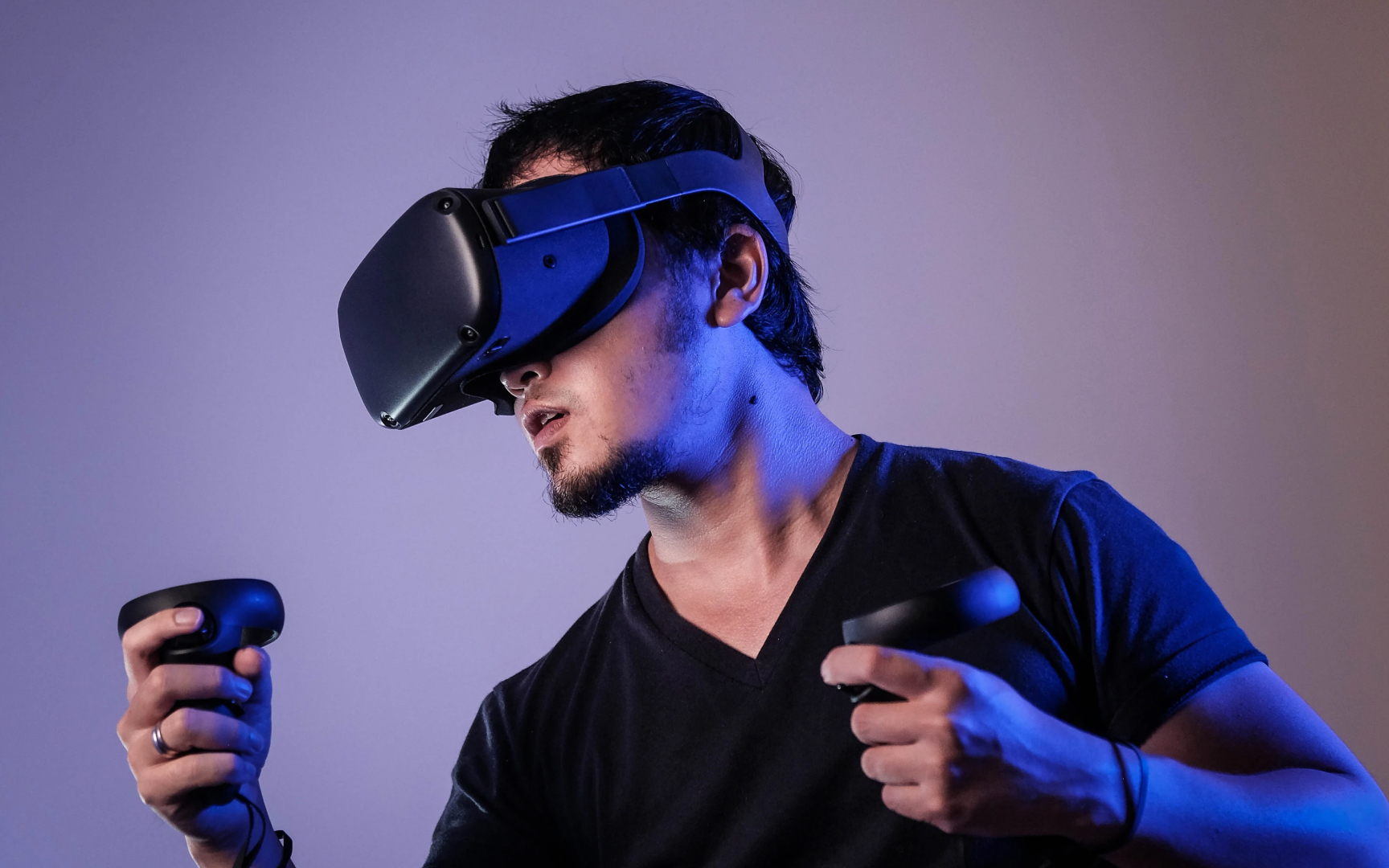
Unlike a game or a film, virtual reality puts users inside the experience rather than in front of it. That shift changes everything about how 3D content needs to be built and rendered.
The core trick is stereoscopic vision. Human eyes are spaced slightly apart, so each eye sees the world from a slightly different angle. The brain fuses those two views into a single image with depth. VR headsets replicate this by rendering the scene twice, once per eye, from offset perspectives. The result is a convincing sense of three-dimensional space on a flat screen.
Head tracking adds the second layer. Sensors detect movement constantly, so when users turn their heads, the view updates instantly. Any noticeable delay between movement and image breaks the illusion and causes disorientation, which is why VR demands far more processing power than standard 3D rendering.
Beyond games, VR has found a strong foothold in professional training. Surgeons rehearse procedures, pilots practice emergency scenarios, and soldiers train for environments too dangerous to replicate physically. In each case, the value is the same: feeling genuinely present in a space rather than simply watching it.
Augmented reality (AR)
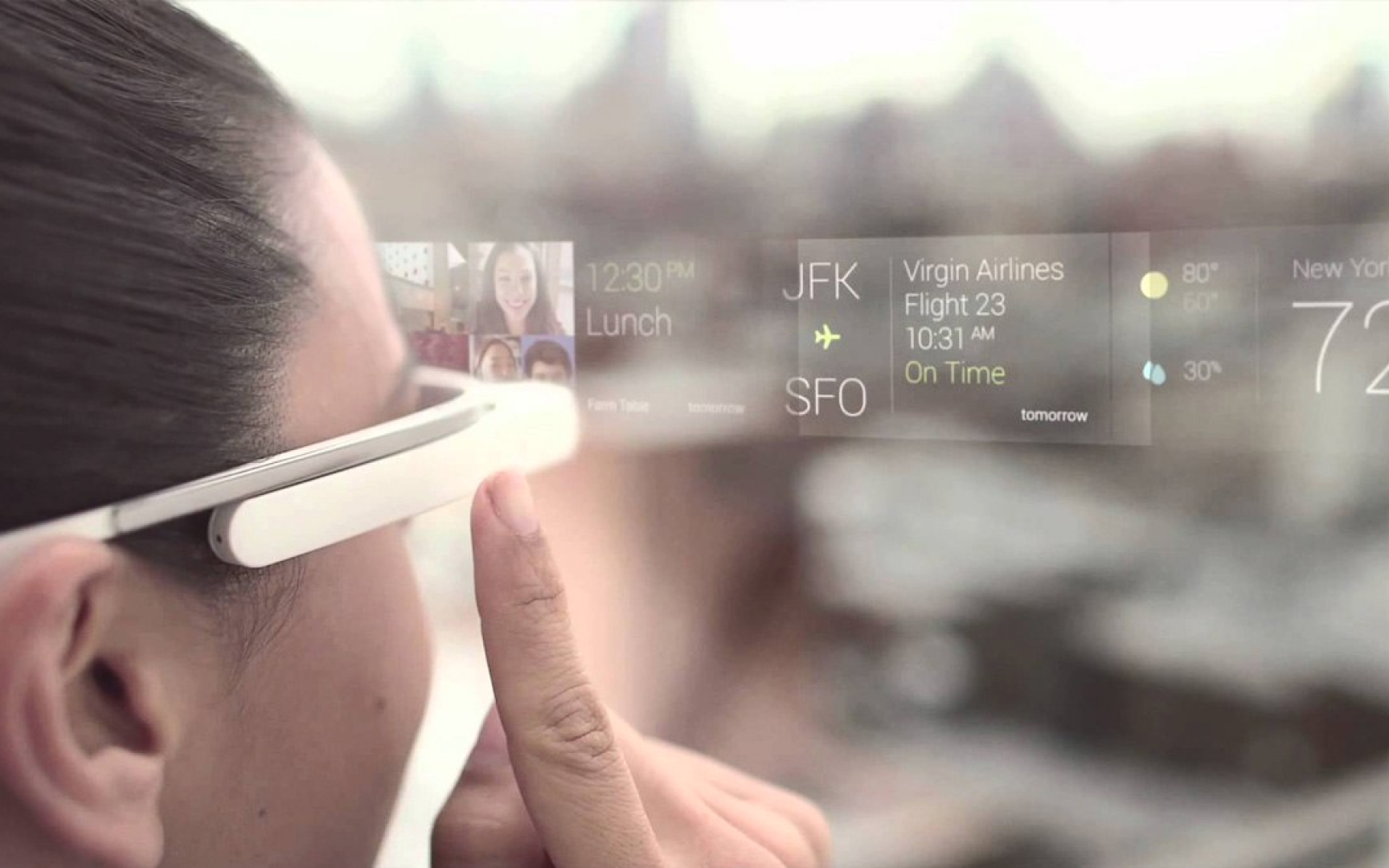
Where VR replaces the real world entirely, augmented reality adds to it. AR overlays digital content, whether 2D graphics or full 3D objects, directly onto the physical environment so users see both at once.
The most familiar examples are consumer-facing. Snapchat filters place 3D objects on users' faces in real time. Pokémon Go anchors digital characters to real-world locations. IKEA's app lets shoppers place furniture in their own rooms before buying. These feel lightweight, but each one depends on a 3D rendering pipeline that must understand the physical space, anchor objects correctly, and update as the camera moves.
Enterprise applications have grown equally fast. Surgeons use AR overlays to see imaging data without looking away from the patient. Warehouse workers follow AR navigation to pick orders faster. Architects walk clients through buildings that haven't been built yet. In each case, AR works because it keeps users present in the real world while adding information they would otherwise need to look elsewhere to find.
From social filters to surgical suites, AR has become one of the broadest application areas for 3D design, and the range keeps expanding.[2]
How 3D glasses create depth
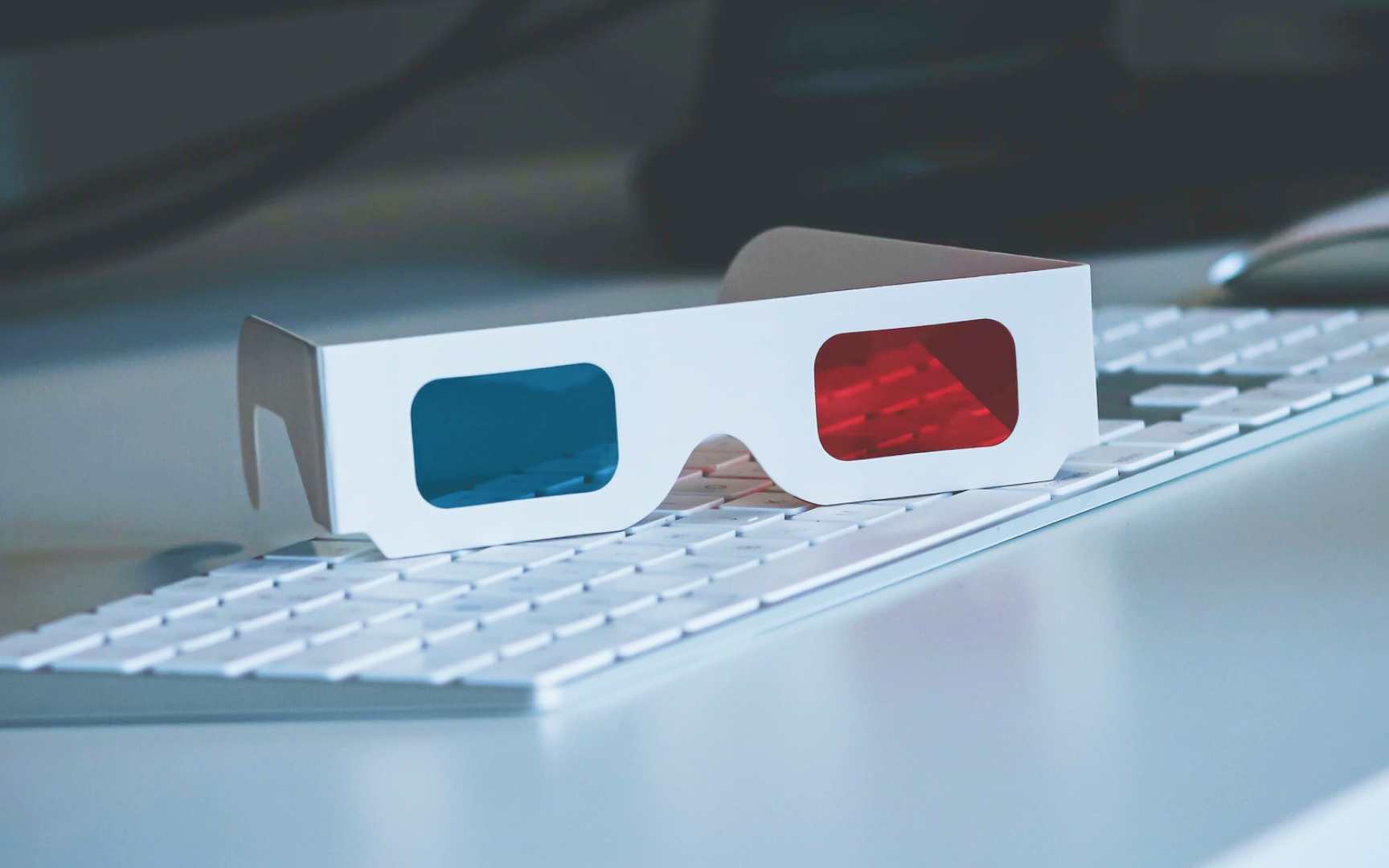
3D glasses work because the brain creates depth from 2 flat images. Each eye sees a slightly different view, and the brain fuses them into one with depth. That's natural vision, and 3D glasses replicate it artificially.
Older anaglyph glasses, with a red lens and a cyan lens, separate images by color. The projector overlays 2 versions of the scene, one tinted red and one tinted cyan. Each lens blocks one color, so each eye receives only the image meant for it. The approach works, but filtering by color distorts the palette, and the result looks off.
Polarized glasses solve this by separating images using light wave orientation. The projector sends 2 images polarized at different angles, one vertical and one horizontal, and each lens passes only its matching orientation. No color is filtered, so the picture stays accurate. Avatar (2009) brought polarized 3D to mass audiences and marked the peak of 3D cinema, with over 70% of its box office coming from 3D screenings.
Both types rely on the same principle as VR headsets: feed each eye a slightly different image and let the brain do the rest. The difference is the delivery, a passive flat screen rather than an immersive device.[3]
3D recognition
3D recognition software identifies objects, faces, or structures by analyzing geometry rather than flat pixels. The system extracts depth information to build a surface model, then compares it against a database to find a match.
Facial recognition is the most widely known application. A 3D scan maps distances between features like eye spacing, nose bridge shape, and jaw contour. Because these measurements are spatial, they are harder to fool with a photograph or mask than 2D systems. Apple's Face ID, introduced with the iPhone X in 2017, projects thousands of infrared dots to build a depth map in under a second.
The technology reaches beyond phones. Law enforcement uses it to search surveillance footage against offender databases. Border agencies use it at passport gates. Each application relies on the same principle: geometry is harder to fake than appearance.
The ethical stakes are real. Public facial recognition raises concerns around consent, accuracy disparities across demographic groups, and the risk of misuse. These questions remain unresolved, and designers working in this space need to understand both the capability and its implications.[4]
3D scanning
3D scanning converts physical objects into digital 3D models by measuring geometry with sensors. Rather than modeling from scratch, scanning captures what already exists as a precise mesh of points.
The main technologies are laser scanning, structured light, and photogrammetry. Laser scanners measure how long a reflected beam takes to return, building a point cloud. Structured light projectors cast a grid onto the surface and read how it distorts to calculate depth. Photogrammetry reconstructs geometry from multiple photographs. Each trades off speed, resolution, and cost differently.
Healthcare is one of the most impactful application areas. Clinicians use body scans to design custom prosthetics and orthotics fitted to a patient's exact anatomy, replacing plaster casting. The scan takes seconds and needs no physical contact, which matters for patients with post-surgical wounds or sensitive residual limbs.
Beyond healthcare, 3D scanning serves film production, architectural documentation, and cultural heritage preservation. In each case, the value is the same: physical reality becomes digital geometry, ready to be modified, fabricated, or archived.[5]
3D printing
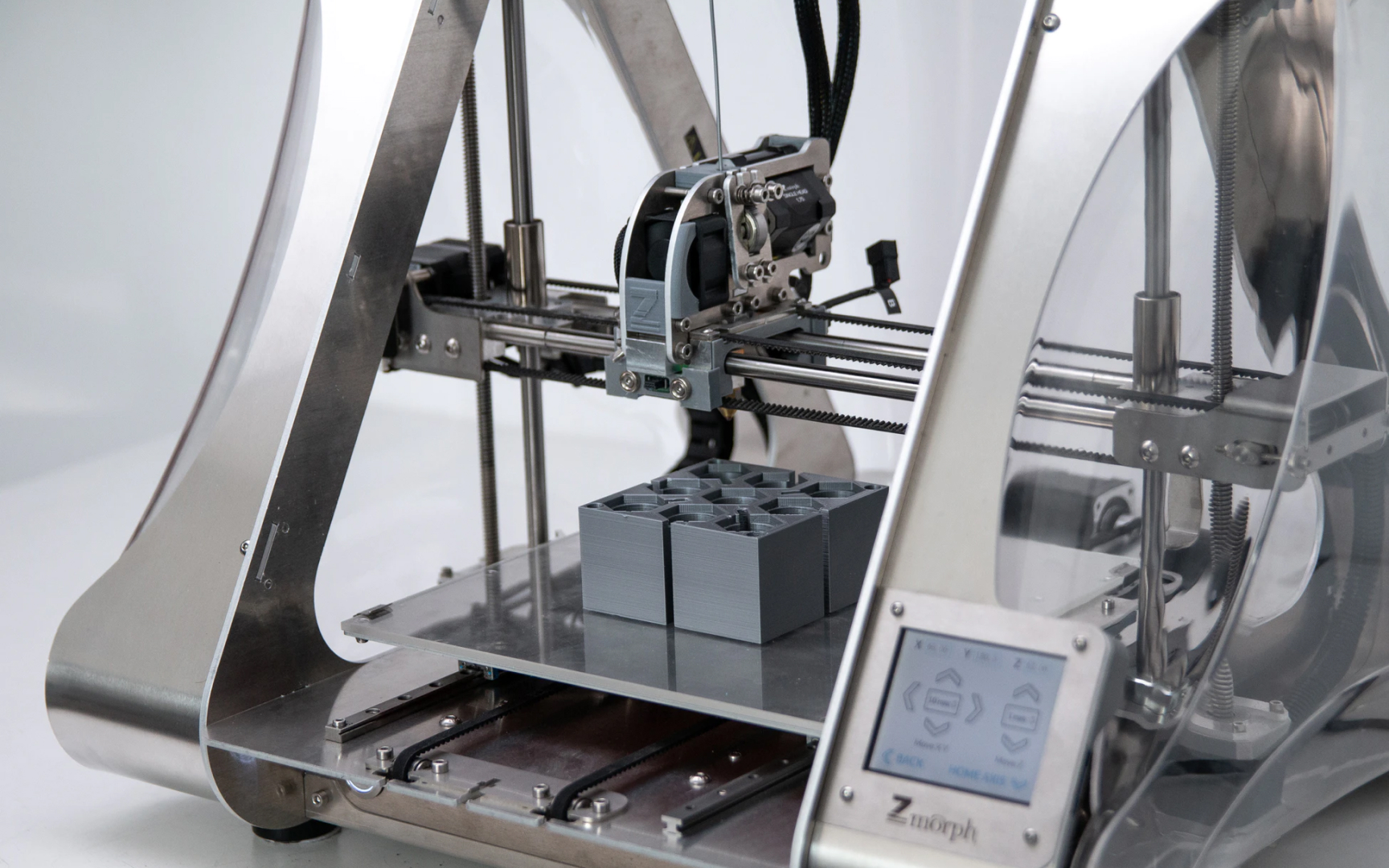
3D printing, also called additive manufacturing, builds physical objects layer by layer from a digital model. Unlike traditional manufacturing, which removes material from a block, 3D printing adds material only where the design requires it, reducing waste and enabling geometries that subtractive methods cannot produce.
The most common process, fused deposition modeling (FDM), melts plastic filament through a nozzle to build each layer. Industrial processes like selective laser sintering use lasers to fuse powdered metals or polymers into parts strong enough for aerospace and medical use. The FDA has cleared over 20 categories of 3D-printed medical devices, including orthopedic implants, surgical guides, and dental restorations.
Materials now include metals, ceramics, composites, silicone, and biomaterials for tissue scaffolds. Entire houses have been printed from concrete. For designers, the most relevant applications are rapid prototyping, where a model goes from file to physical object in hours, and custom production, where one-off parts become as practical as mass manufacturing.[6]
3D sound
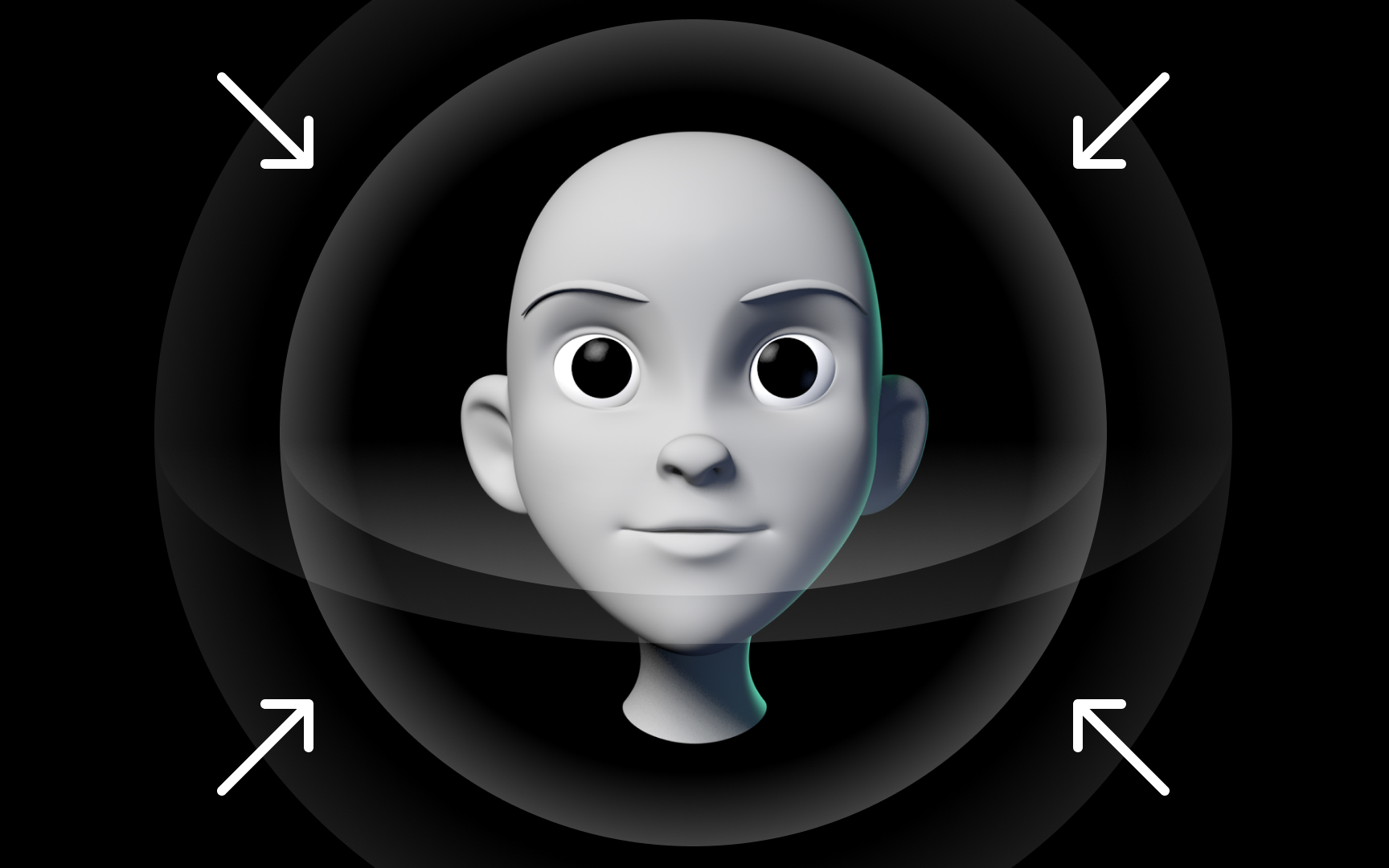
Humans locate sounds in 3 dimensions naturally. The brain reads tiny differences in when and how sound reaches each ear, factoring in how the ear canal and head shape alter the signal by direction. This gives a sense of height and depth in sound, not just left and right.
3D sound, also called spatial audio, replicates this in playback. The core technique is the head-related transfer function (HRTF), a mathematical model of how a person's anatomy modifies sound before it reaches the eardrums. By applying HRTF filters to audio, software simulates a sound coming from behind, above, or from a specific point in space, even through standard headphones.
Surround sound systems achieve a related effect with speakers placed around the listener. HRTF-based processing achieves the same result synthetically, which is why spatial audio works in VR headsets, games, and streaming services.
For designers, 3D sound is increasingly relevant. Games rely on spatial audio for gameplay awareness. Platforms like Apple Music and Netflix use Dolby Atmos to place sounds across a 3D field. As spatial computing grows, audio that exists in space becomes a core design material alongside visuals.
3D architecture and industrial design

3D modeling is central to both architecture and industrial design. Architects build full digital models before construction begins. Engineers design products with every component specified in 3D. These are working tools for testing structural loads, simulating materials, and coordinating with contractors, not just presentations.
The shift from 2D drafting changed what was possible at the design stage. A 3D model reveals conflicts, like 2 pipes routed through the same wall, that a flat drawing misses. It lets clients walk through a building before it exists rather than reading a floor plan. In industrial design, a 3D model feeds directly into CNC machines or 3D printers, closing the gap between design and production.
UI design is increasingly part of this space. Spatial computing platforms require interfaces that live in three-dimensional space, not flat screens. Designers think about depth, scale, and how digital elements relate to physical surroundings. The line between product, architectural, and UI design blurs as the surfaces designers work on converge.[7]
Spatial computing and XR interfaces
Spatial computing merges digital content with physical space. Instead of a flat screen, users interact with digital objects placed in the world around them. XR, or extended reality, covers this spectrum: AR overlays content on the real world, VR replaces it, and mixed reality blends both. Apple Vision Pro, released in 2024, was the first device to bring this to mainstream consumers.[8]
For designers, this changes interface design fundamentally. On a flat screen, the layout is two-dimensional. In spatial computing, interfaces live in 3 dimensions and must account for depth, scale, and position. A button is no longer at a pixel coordinate. It is anchored in an environment, and its legibility depends on how far users stand from it. Inputs change: gaze, hand gestures, and voice replace taps and clicks.
New constraints apply. Content too far to the side forces users to turn their heads uncomfortably. Elements too close create discomfort. Layout rules that work on a phone fail when the environment itself is the interface.
For product designers, spatial computing is not a niche. It is the direction dominant platforms are heading, and foundational 3D knowledge is the prerequisite for working in it.[9]
Topics
References
- Global games market at $74.2 billion annually - Superdata | GamesIndustry.biz
- Augmented reality - Wikipedia
- Why aren't 3-D glasses red and blue anymore? | HowStuffWorks
- Facial Recognition Technology: How It Works, Where It's Used, and What It Means for Privacy | GovFacts
- 3D scanning - Wikipedia
- 3D printing - Wikipedia
- Evolution of 3D Modeling In Architecture and Design: a 30-year Retrospective | ArchiCGI
- Mastering Spatial Design: Key Principles Inspired by Apple | Uxcel
- UI Animation Trends & UX Design Blog (2026) | Ripplix | Ripplix